
For older adults comparing over-the-counter hearing aids, I put the ELEHEAR-Beyond Pro first for its Bluetooth-focused feature set, while the EarCentric EasyCharge stands out for its behind-the-ear design and charging options. The Audien Atom One is a compact alternative for shoppers who prefer an in-ear style. The main tradeoffs are ease of handling versus discreet fit, and simple controls versus more features that may take time to learn. Match the device to the wearer’s hearing needs, dexterity, daily routine, and willingness to manage charging and cleaning. Read on for the full comparison, selection criteria, and advice on choosing between these 15 options.

Turn quiet afternoons into listening time
- Thousands of audiobooks, podcasts and originals
- Listen on your phone, tablet or Echo — also offline
- Cancel anytime
Complete the kit


Key Takeaways
- ELEHEAR-Beyond Pro leads for feature-oriented shoppers: Its Bluetooth focus gives it a distinct role, but buyers should decide whether connected features are useful enough to justify a more involved setup.
- EarCentric EasyCharge has the clearest handling-focused case: Its BTE format and desktop and portable charging options may suit older adults who find tiny in-ear devices difficult to insert or keep track of.
- Compact in-ear designs trade easy concealment for handling demands: HEARO CIC and Audien Atom One are alternatives for buyers prioritizing a low-profile fit, though fit, cleaning, and insertion comfort need attention.
- Battery claims are not directly interchangeable: Listings cite figures such as 35 hours, 100 hours, and 500 hours, but buyers should check what the figure measures and how often the device itself needs recharging.
- Noise reduction labels do not establish clinical suitability: The lineup includes multiple noise-reduction claims, but shoppers should prioritize a professional hearing assessment when hearing loss is sudden, uneven, severe, or accompanied by other symptoms.
| ELEHEAR-Beyond Pro Bluetooth Hearing Aids for Seniors |  | Best for App-Based Customization | Design: Receiver-in-Canal (RIC) | Sound technology: VocClear 2.0 | Frequency response: Up to 8500 Hz | VIEW ON AMAZON | See Our Full Breakdown |
| Rechargeable Hearing Aid for Adults and Elderly with 16-Channel AI Noise Reduction |  | Best for Simple Button Controls | Fit: Behind-the-ear | Processing: 16-channel AI digital processing | Noise control: Active noise cancellation | VIEW ON AMAZON | See Our Full Breakdown |
| Oricle Hearing Aids for Seniors and Adults with Noise Cancellation and Portable Charging Case |  | Best for Long Wear Between Charges | Fit: In-ear silicone | Noise control: Advanced noise cancellation | Battery life: Up to 60 hours | VIEW ON AMAZON | See Our Full Breakdown |
| HEARO OTC Hearing Aids for Seniors, Rechargeable CIC Invisible Pair |  | Best for App-Free Discreet Wear | Type: OTC, completely-in-canal | Stated hearing-loss range: Mild to moderate | Battery life: Up to 12 hours | VIEW ON AMAZON | See Our Full Breakdown |
| Audien Atom One OTC Hearing Aids | 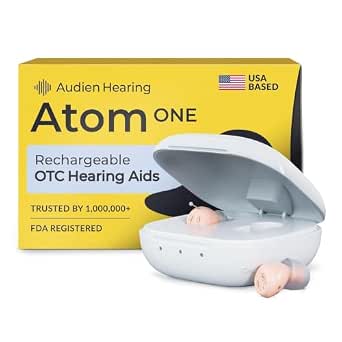 | Best for Hands-On Manual Adjustment | Fit: In-ear | Controls: Analog dial control | Adjustments: Volume and frequency | VIEW ON AMAZON | See Our Full Breakdown |
| OTC Hearing Aids for Seniors with Noise Cancelling, 100 Hours Battery Life | 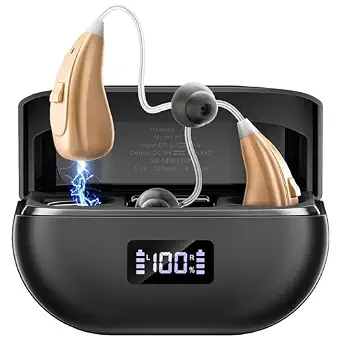 | Best for Simple Controls and Long Daily Use | Noise control: Adaptive noise cancellation | Battery life: 25+ hours per charge; 100+ hours with charging case | Battery type: Lithium-ion | VIEW ON AMAZON | See Our Full Breakdown |
| EarCentric EasyCharge Rechargeable Hearing Aids for Seniors and Adults, Pair with Desktop Charger and Portable Charging Case, Behind-the-Ear BTE OTC Hearing Aids with Noise Reduction, Beige |  | Best for Flexible Charging | Fit: Behind-the-ear | Charging: Desktop charger and portable charging case | Stated use duration: Up to 12 days on a single charge | VIEW ON AMAZON | See Our Full Breakdown |
| Rechargeable Hearing Aids for Seniors and Adults with Noise Reduction |  | Best for Multiple Listening Modes | Fit: Behind-the-ear | Battery: Built-in rechargeable lithium-ion battery | Use time: Up to 20 hours | VIEW ON AMAZON | See Our Full Breakdown |
| Rechargeable Hearing Aids for Seniors with Noise Canceling and Volume Control |  | Best for Moisture-Exposed Daily Routines | Material and coating: Nano-coated, waterproof and sweat-proof | Battery life: 80 hours | Charging time: 2 to 4 hours | VIEW ON AMAZON | See Our Full Breakdown |
| Flaygo Rechargeable Hearing Aids for Seniors | 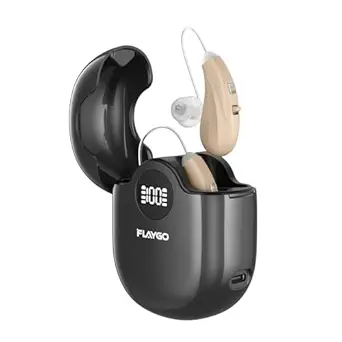 | Best for Lightweight Behind-the-Ear Wear | Fit: Behind-the-ear | Weight: 3.5 grams | Digital processing: 16-channel digital chip | VIEW ON AMAZON | See Our Full Breakdown |
| Rechargeable Hearing Aids for Seniors with Automatic UV Cleaning |  | Best for Simple Daily Care | Battery life per charge: 15–20 hours | Total battery life with case: Up to 120 hours | Volume levels: 5 | VIEW ON AMAZON | See Our Full Breakdown |
| Hearing Aid for Seniors, Noise Cancelling, 500 Hours Per Battery Life |  | Best for Long Battery Swaps | Power source: Battery powered | Battery cell composition: Zinc-air | Battery life: Up to 500 hours per battery | VIEW ON AMAZON | See Our Full Breakdown |
| Rechargeable Hearing Aids for Seniors with Noise Cancelling, Behind-The-Ear Severe Hearing Loss Amplifier |  | Best for a Behind-the-Ear Fit | Weight: 5.5 g | Battery life: Up to 25 hours | Charging options: Cable and charging case | VIEW ON AMAZON | See Our Full Breakdown |
| SOUNDFIT Hearing Aids for Seniors & Adults with Superior Sound Quality |  | Best for Different Listening Environments | Chipset: Intricon A4 digital chip | Channels: 16-channel sound processing | Listening modes: Normal, Restaurant, Outdoor, Music | VIEW ON AMAZON | See Our Full Breakdown |
| Rechargeable Hearing Aids for Seniors, 16-Channel DSP Noise Reduction, Invisible In-Ear Design, Volume Control, 35 Hours Battery Life with Charging Case |  | Best for Discreet Rechargeable Wear | Fit type: In-ear | Power source: Rechargeable battery | Battery life: 35 hours (specification; description also states up to 140 hours of use on a two-hour charge) | VIEW ON AMAZON | See Our Full Breakdown |
| hearing aids for older adult | Battery life | Controls |
|---|---|---|
| ELEHEAR-Beyond Pro Bluetooth H | Up to 20 hours | — |
| Rechargeable Hearing Aid for A | Up to 30 hours per charge | Button control |
| Oricle Hearing Aids for Senior | Up to 60 hours | — |
| HEARO OTC Hearing Aids for Sen | Up to 12 hours | Single button for volume and program selection |
| Audien Atom One OTC Hearing Ai | — | Analog dial control |
| OTC Hearing Aids for Seniors w | 25+ hours per charge; 100+ hours with charging case | One-button control; five volume levels |
| EarCentric EasyCharge Recharge | — | — |
| Rechargeable Hearing Aids for | — | Button control |
| Rechargeable Hearing Aids for | 80 hours | Adjustable volume |
| Flaygo Rechargeable Hearing Ai | — | — |
| Rechargeable Hearing Aids for | — | — |
| Hearing Aid for Seniors | Up to 500 hours per battery | Button control |
| Rechargeable Hearing Aids for | Up to 25 hours | — |
| SOUNDFIT Hearing Aids for Seni | Up to 38 hours per charge | — |
| Rechargeable Hearing Aids for | 35 hours (specification; description also states up to 140 hours of use on a two-hour charge) | Button control |
More Details on Our Top Picks
ELEHEAR-Beyond Pro Bluetooth Hearing Aids for Seniors
The ELEHEAR-Beyond Pro is the strongest match here for older adults who want hearing support paired with smartphone features. Its RIC fit and VocClear 2.0 processing are designed to sharpen speech detail, while the listed 8 ms latency matters when listening to audio over Bluetooth. Compared with the Audien Atom One, which relies on manual analog dials, the ELEHEAR offers app-based adjustments, soundscapes, and real-time translation in 20 languages. That flexibility has a cost in convenience: getting the full feature set requires a compatible phone and comfort with an app. Its small components may also be harder to handle than larger behind-the-ear controls. I’d choose it for tech-comfortable users who value connectivity, but not for someone seeking the simplest possible setup.
Pros:- Bluetooth and companion-app controls provide more adjustment options than the Audien Atom One’s analog dials.
- Listed 8 ms latency supports more synchronized Bluetooth audio.
- Up to 20 hours of battery life, with a 15-minute charge providing up to six hours of use.
- Real-time AI translation in 20 languages and 20 soundscapes add features beyond basic amplification.
Cons:- Full adjustment and feature access depends on using a compatible smartphone app.
- Small components may be difficult for people with limited dexterity to insert or handle.
- The feature-rich approach may be more complicated than the button or dial controls on simpler options.
Best for: Older adults comfortable using an iOS or Android app who want Bluetooth, adjustable sound options, and translation features.
Not ideal for: People who avoid smartphones or have difficulty handling small hearing-aid components, since key adjustments depend on the app and the RIC pieces are small.
- Design:Receiver-in-Canal (RIC)
- Sound technology:VocClear 2.0
- Frequency response:Up to 8500 Hz
- Latency:8 ms
- Battery life:Up to 20 hours
- Fast charging:15 minutes for up to 6 hours of use
- Charging case:Provides 4 additional full charges
- Connectivity and app:Bluetooth; iOS and Android app
- Additional features:AI translation in 20 languages; 20 soundscapes
Our verdict“Choose the ELEHEAR-Beyond Pro if you want app-based sound options and Bluetooth features and are comfortable managing small devices and smartphone settings.”
Rechargeable Hearing Aid for Adults and Elderly with 16-Channel AI Noise Reduction
This behind-the-ear option stands out for older adults who want noise processing without making a phone app the center of daily use. Its 16-channel AI processing is intended to adjust sound and reduce background noise, while physical buttons offer a direct alternative to the app-based controls on the ELEHEAR-Beyond Pro. The listed 30-hour battery life and case capacity of 10 full charges may also suit users who prefer fewer charging interruptions. The tradeoff is a more basic, plastic construction and less information about ongoing software updates. The product description cites use for mild to severe hearing loss, but buyers should confirm suitability with a hearing-care professional rather than treating that claim as a substitute for an evaluation. It is a practical pick for users who value straightforward controls and extended battery support over connected extras.
Pros:- Physical buttons are a straightforward alternative to the ELEHEAR-Beyond Pro’s app-based adjustments.
- 16-channel AI processing is designed to adapt sound and reduce background noise.
- Listed battery life is up to 30 hours per charge.
- Charging case is specified to provide 10 full charges.
Cons:- Plastic construction may feel less substantial than buyers seeking a more premium finish expect.
- Software update support is not specified.
- Behind-the-ear placement is more visible than the in-ear designs of the Oricle and Audien Atom One.
Best for: Older adults who prefer physical button controls, a behind-the-ear fit, and a charging case with multiple recharges.
Not ideal for: Buyers seeking a discreet in-ear design, confirmed long-term software support, or detailed app-based customization.
- Fit:Behind-the-ear
- Processing:16-channel AI digital processing
- Noise control:Active noise cancellation
- Controls:Button control
- Battery life:Up to 30 hours per charge
- Charging time:1–2 hours
- Charging case:Capacity for 10 full charges
- Weight:3.5 g
- Power source:Lithium-ion battery
Our verdict“Pick this model if button operation and extended battery support matter more to you than a discreet fit or app-driven customization.”
Oricle Hearing Aids for Seniors and Adults with Noise Cancellation and Portable Charging Case
The Oricle is a straightforward in-ear choice for older adults who care most about extended use and easy handling. Its listed up to 60 hours of battery life is the standout distinction in this group, while the portable case and automatic on/off behavior can reduce routine button presses. Five sound levels offer basic adjustment without the wider app feature set of the ELEHEAR-Beyond Pro. Compared with the Audien Atom One, the Oricle emphasizes noise cancellation and case-based operation rather than manual frequency adjustments. That simplicity also limits fine control: users must select sound levels manually, and an in-ear fit can be uncomfortable or insecure for some ear shapes. I’d put it ahead of more feature-heavy choices for buyers who want simple daily use, but fit should take priority over the battery claim.
Pros:- Listed battery life of up to 60 hours sets it apart from the ELEHEAR-Beyond Pro’s 20-hour figure.
- Portable charging case supports on-the-go charging.
- Automatic on/off with the case can reduce repeated manual operation.
- Five sound levels provide basic adjustment without requiring a companion app.
Cons:- Sound levels require manual selection rather than app-based fine tuning.
- The in-ear design may not fit every ear shape comfortably.
- The supplied information does not specify charging time or case charge capacity.
Best for: Older adults who prefer an in-ear device with simple sound-level choices, automatic case operation, and a long stated battery life.
Not ideal for: People whose ear shape makes silicone in-ear devices uncomfortable, or users who need app-based tuning and detailed adjustments.
- Fit:In-ear silicone
- Noise control:Advanced noise cancellation
- Battery life:Up to 60 hours
- Charging case:Portable
- Sound levels:5 adjustable levels
- Power control:Long press to turn on or off
- Automatic operation:Auto on/off with case
Our verdict“Choose the Oricle if you want simple in-ear operation and prioritize long stated battery life, provided its ear-tip fit works for you.”
HEARO OTC Hearing Aids for Seniors, Rechargeable CIC Invisible Pair
HEARO is the most discreet, deliberately simple option in this group: its completely-in-canal design sits inside the ear, and its single button handles volume and program selection without a smartphone. That makes it a clearer fit for older adults who want less visible devices than the 16-channel AI behind-the-ear model, and less setup complexity than the app-dependent ELEHEAR. HEARO is specifically described for mild to moderate hearing loss, with two listening programs and up to 12 hours of battery life. Those limits matter: it offers fewer adjustments than the Oricle’s five levels and no stated noise-cancellation feature. I’d favor it for discreet social or work settings and uncomplicated controls, but not for someone who needs extensive sound tuning or support beyond the stated hearing-loss range.
Pros:- Completely-in-canal design is less visible than the behind-the-ear 16-channel model.
- Single-button operation avoids the smartphone-app requirement of the ELEHEAR-Beyond Pro.
- Includes small, medium, and large silicone domes for fit adjustment.
- USB-C charging case and up to 12 hours of stated battery life support daily use.
Cons:- Limited to the stated use for mild to moderate hearing loss.
- Two listening programs offer fewer options than the Oricle’s five sound levels.
- No noise-cancellation feature is listed.
Best for: Adults with mild to moderate hearing loss who want a low-visibility in-ear style and prefer physical controls over smartphone setup.
Not ideal for: People seeking more than two listening programs, noise cancellation, or a device intended for hearing loss outside the stated mild-to-moderate range.
- Type:OTC, completely-in-canal
- Stated hearing-loss range:Mild to moderate
- Battery life:Up to 12 hours
- Charging:Rechargeable USB-C charging case
- Controls:Single button for volume and program selection
- Listening programs:2
- Fit accessories:Small, medium, and large silicone domes
- Listed features:Feedback reduction, sweatproof design, lightweight
Our verdict“Choose HEARO if discreet wear and app-free controls outweigh the need for extensive listening adjustments or noise cancellation.”
Audien Atom One OTC Hearing Aids
The Audien Atom One suits older adults who want direct analog controls rather than navigating an app or menu. Its dials adjust volume and frequency, giving users a hands-on way to change sound; the tradeoff is that every adjustment is manual, unlike the ELEHEAR-Beyond Pro’s app-based options. The discreet in-ear fit and included expert setup support may appeal to first-time OTC buyers who want help getting started. Compared with HEARO, which uses a single button and two programs, the Atom One puts more adjustment responsibility in the wearer’s hands. It has no noise-control feature, though, so it is a weaker choice for busy environments than the Oricle, which lists noise cancellation. I’d choose it for simple, personal adjustment in quieter routines, not for automatic sound management.
Pros:- Analog dials allow direct volume and frequency adjustment without an app.
- Discreet in-ear design is less visible than the 16-channel behind-the-ear option.
- Rechargeable lithium-ion batteries are specified.
- Expert-guided setup and multiple ear-dome sizes are listed as included support and accessories.
Cons:- No noise-control feature is listed, unlike the Oricle’s noise cancellation.
- Sound changes require manual volume and frequency adjustments.
- Software update support is not specified.
Best for: First-time OTC users who want an in-ear design, hands-on volume and frequency dials, and guided setup support.
Not ideal for: People who struggle with small dials, want noise control in busy settings, or prefer automatic or app-based sound adjustments.
- Fit:In-ear
- Controls:Analog dial control
- Adjustments:Volume and frequency
- Battery:Rechargeable lithium-ion batteries
- Noise control:None listed
- Color:Beige
- Materials:Plastic or silicone
- Setup support:Expert-guided setup
Our verdict“Choose the Audien Atom One if you want discreet wear and manual dials, and do not need noise processing or app-based adjustments.”
OTC Hearing Aids for Seniors with Noise Cancelling, 100 Hours Battery Life
For older adults who want a straightforward routine, this pair keeps operation to one button and five volume levels. Each charge is listed for more than 25 hours, while the case brings total use to over 100 hours, so frequent charging is less of a concern than with the Flaygo Rechargeable Hearing Aids, which specify 80 hours of standby time. Adaptive noise cancellation is intended to make conversation easier to follow amid background sound, though the listing does not explain how its modes behave in different settings. At 3 grams per aid, the lightweight build may suit extended wear. The tradeoff is limited fine-tuning: people who need detailed adjustments or support for severe hearing loss should look elsewhere. Charging is also part of the routine, unlike models that use replaceable batteries.
Pros:- One-button control reduces the number of steps needed for everyday volume changes.
- More than 25 hours per charge and over 100 hours with the case can reduce charging frequency.
- Each aid weighs 3 grams, supporting a lightweight fit.
- Adaptive noise cancellation is designed to help clarify conversation around background noise.
Cons:- Rechargeable design may not suit users who prefer replaceable batteries or cannot manage regular charging.
- Five volume levels offer less adjustment than a more finely configurable device.
- The product description says it may not suit severe hearing loss and gives limited detail on fitting or sound adjustment.
Best for: Older adults who want lightweight rechargeable aids, uncomplicated controls, and fewer charging interruptions during travel or daily routines.
Not ideal for: People with severe hearing loss or buyers who need multiple listening adjustments beyond five volume levels.
- Noise control:Adaptive noise cancellation
- Battery life:25+ hours per charge; 100+ hours with charging case
- Battery type:Lithium-ion
- Weight:3 grams each
- Controls:One-button control; five volume levels
- Material:Medical-grade silicone
- Color:Blackish-silver
Our verdict“Choose this pair if you value simple controls and long case-supported use more than extensive sound customization.”
EarCentric EasyCharge Rechargeable Hearing Aids for Seniors and Adults, Pair with Desktop Charger and Portable Charging Case, Behind-the-Ear BTE OTC Hearing Aids with Noise Reduction, Beige
The EarCentric EasyCharge stands apart for its two charging options: a desktop charger for a regular home setup and a portable case for use away from home. That arrangement may help older adults who prefer a dedicated charging spot but still want backup on outings. Its behind-the-ear fit keeps the device outside the ear canal, while adjustable volume and noise reduction offer practical everyday controls. Compared with the more compact-feeling Flaygo Rechargeable Hearing Aids, this model is listed at 1.2 ounces for the item, so buyers should not assume it will feel as light. The listing claims up to 12 days of use on a charge, but gives limited detail about how that duration is measured. Its beige color and BTE form are also more visible than an in-ear design.
Pros:- Desktop charger and portable charging case provide options for home and travel routines.
- Behind-the-ear fit avoids placing the main device inside the ear canal.
- Adjustable volume gives users a way to adapt amplification to changing listening needs.
- Noise reduction is included for everyday listening environments.
Cons:- The listed item weight of 1.2 ounces may feel less lightweight than the 3.5-gram Flaygo aids.
- The stated use of up to 12 days is not accompanied by details on usage conditions.
- The beige behind-the-ear design may be more noticeable than compact in-ear alternatives.
Best for: Older adults who want a behind-the-ear style and both a home desktop charger and portable charging option.
Not ideal for: Buyers seeking the smallest or least visible fit, or those who want clearly documented charging duration and long-term software support.
- Fit:Behind-the-ear
- Charging:Desktop charger and portable charging case
- Stated use duration:Up to 12 days on a single charge
- Battery:Included 3.7-volt lithium-polymer battery
- Noise control:Environmental noise cancellation
- Features:Adjustable, rechargeable, sweatproof, volume control
- Item dimensions:1.4 × 0.5 inches
- Item weight:1.2 ounces
Our verdict“Pick EarCentric EasyCharge if having both a fixed home charger and a portable charging option matters more than a minimal, discreet profile.”
Rechargeable Hearing Aids for Seniors and Adults with Noise Reduction
This behind-the-ear pair is the choice in this group for shoppers who want multiple listening modes alongside straightforward button controls. Modes can be useful when moving between different environments, although the product details do not name the modes or explain how to select them. The stated 20 hours of use from a two-hour charge, plus 72 hours of backup power from the case, gives a clearer charging picture than the EarCentric EasyCharge listing, which describes up to 12 days without spelling out usage conditions. Its one-button operation may be approachable for people who do not want app-based controls. The tradeoffs are a limited style choice, daily charging for regular use, and a listed weight of 7.36 ounces that is much higher than the 3.5-gram Flaygo figure; confirm how that weight is measured before choosing for comfort.
Pros:- Multiple listening modes offer more environment-specific options than a single fixed setting.
- One-button control keeps routine operation simple.
- The listing gives a defined 20-hour use estimate and 72 hours of case backup.
- Behind-the-ear design may appeal to users who prefer not to place the main aid in the ear canal.
Cons:- The 20-hour use estimate means regular charging is part of daily use.
- The product is described as potentially unsuitable for severe hearing loss.
- The listed 7.36-ounce weight is far above the 3.5-gram figure for Flaygo, and its measurement basis is unclear.
Best for: Older adults who prefer a behind-the-ear fit, physical controls, and selectable listening modes for varied everyday settings.
Not ideal for: People who need severe-hearing-loss support, want a discreet in-ear style, or prefer not to charge a device daily.
- Fit:Behind-the-ear
- Battery:Built-in rechargeable lithium-ion battery
- Use time:Up to 20 hours
- Charge time:2 hours
- Case backup:72 hours
- Controls:Button control
- Noise control:Active noise cancellation
- Materials and style:Plastic and silicone; beige
Our verdict“Choose this model if listening modes and simple physical controls matter more to you than a clearly documented lightweight build.”
Rechargeable Hearing Aids for Seniors with Noise Canceling and Volume Control
The clearest point of difference here is the nano-coated, waterproof and sweat-proof shell, which may suit older adults who want less worry around perspiration or damp conditions. The listing also states 80 hours of battery life and a two-to-four-hour charge, making its endurance claim longer than the Flaygo model’s 80 hours of standby rather than use. That distinction matters: the product details do not explain the conditions behind its 80-hour figure, nor do they specify the fit or ear-size range. Noise reduction and adjustable volume are useful basics, but the claim of 30% higher noise reduction lacks a stated comparison method. Compared with the EarCentric EasyCharge, which clearly uses a behind-the-ear fit, this model leaves more questions about how it sits and feels.
Pros:- Nano-coated, waterproof and sweat-proof construction is aimed at handling moisture exposure.
- The listing states up to 80 hours of battery life.
- A portable case supports carrying and charging away from home.
- Adjustable volume and noise reduction provide basic listening controls.
Cons:- No fit type or details for different ear sizes are provided, making comfort harder to judge.
- The 80-hour battery claim does not specify usage conditions.
- The claimed 30% higher noise reduction has no named comparison baseline.
Best for: Older adults who want rechargeable aids with a moisture-resistant shell for active, perspiration-prone daily routines.
Not ideal for: Buyers who need documented fit details, a stated water-resistance rating, or precise evidence behind noise-reduction and battery claims.
- Material and coating:Nano-coated, waterproof and sweat-proof
- Battery life:80 hours
- Charging time:2 to 4 hours
- Noise reduction:Claimed 30% higher than usual
- Controls:Adjustable volume
- Charging accessory:Portable case
- Certifications:FCC and RoHS
Our verdict“Consider this pair if moisture resistance is your priority, but choose a model with clearer fit information if comfort and placement are uncertain.”
Flaygo Rechargeable Hearing Aids for Seniors
Flaygo earns its place for shoppers who care about a lightweight behind-the-ear design and clear, limited controls. Each aid weighs 3.5 grams, and the one-button interface offers four volume levels—fewer than the five on the 100-hour OTC Hearing Aids, but potentially easier for someone who wants a small set of choices. Its 16-channel digital chip, noise reduction and whistling suppression are presented as tools for clearer listening, though the listing does not provide fitting guidance or explain how the channels can be adjusted. USB-C charging takes two hours, while 80 hours is specified as standby time, not continuous use; that is less directly comparable to the other model’s stated hours per charge. Buyers should also note that water and dust resistance ratings are not supplied.
Pros:- At 3.5 grams, the listed weight supports a lightweight behind-the-ear design.
- One-button operation keeps volume changes straightforward.
- Two-hour USB-C charging offers a defined charging period.
- Noise reduction and whistling suppression are included in the described sound processing.
Cons:- Four volume levels may not provide enough adjustment for users with changing listening needs.
- The 80-hour figure is standby time, not a stated continuous-use duration.
- No water or dust resistance rating is provided.
Best for: Older adults who prioritize a light BTE device, simple volume changes, and USB-C charging over extensive customization.
Not ideal for: People who need more than four volume levels, a stated water-resistance rating, or a verified measure of all-day operating time.
- Fit:Behind-the-ear
- Weight:3.5 grams
- Digital processing:16-channel digital chip
- Noise control:Active noise cancellation and whistling suppression
- Battery type:Lithium-ion
- Charging time:2 hours
- Standby time:80 hours
- Controls and color:Button control, four volume levels; beige
- Compatible devices:Smartphone, tablet and television
Our verdict“Choose Flaygo if a lightweight BTE fit and uncomplicated USB-C charging matter more than detailed controls or proven moisture protection.”
Rechargeable Hearing Aids for Seniors with Automatic UV Cleaning
For older adults who want routine care and controls kept straightforward, this model pairs automatic on/off operation with a one-minute UV cleaning cycle whenever the aids return to the case. Five on-device volume levels avoid app setup, while the case supplies up to 120 hours of total power—a useful buffer for people who do not want to charge every day. Compared with the SOUNDFIT hearing aids, this model gives up listening modes and detailed sound-processing specifications in favor of simpler handling and built-in cleaning. The tradeoff is that it has no Bluetooth or smartphone connectivity, and the eartips need to fit securely for clear sound and less feedback. I’d choose it for uncomplicated daily use, not for app-based adjustment or highly tailored listening.
Pros:- Turns on and off automatically when removed from or returned to the case
- One-minute UV cycle adds a simple cleaning step to the charging routine
- Five on-device volume levels require no app setup
- Case provides up to 120 hours of total power
Cons:- No Bluetooth, smartphone, or app connectivity
- Poorly fitted eartips can reduce clarity and contribute to feedback
Best for: Older adults who prefer physical volume controls, automatic charging-case operation, and a built-in cleaning routine without using a smartphone.
Not ideal for: Buyers who want Bluetooth streaming, app adjustments, or several listening modes; those needing to fine-tune fit should also be prepared to try the included eartip sizes.
- Battery life per charge:15–20 hours
- Total battery life with case:Up to 120 hours
- Volume levels:5
- UV cleaning cycle:1 minute
- Eartips:Multiple soft silicone sizes
- Ear compatibility:Interchangeable left/right
- Connectivity:No Bluetooth, smartphone, or app required
Our verdict“Choose this model if hands-off charging and basic controls matter more than Bluetooth or environment-specific sound settings.”
Hearing Aid for Seniors, Noise Cancelling, 500 Hours Per Battery Life
This behind-the-ear amplifier suits older adults who would rather replace a battery occasionally than keep a rechargeable device on a charger. Its stated up to 500 hours per battery can reduce how often power needs attention, while button controls, noise reduction, and multiple frequency modes offer basic ways to adjust listening. Unlike the rechargeable severe-hearing-loss model in this group, it is described for mild to moderate hearing loss; the long battery life does not make it a substitute for a professionally fitted device when hearing needs are greater. It also requires zinc-air battery replacements, so buyers should be comfortable keeping spares on hand. I’d favor this over the rechargeable picks only when battery longevity between changes is the main priority.
Pros:- Stated battery life of up to 500 hours per battery
- Behind-the-ear design is described as lightweight and comfortable
- Noise reduction and multiple frequency modes provide basic listening adjustments
- Includes a cleaning brush for routine maintenance
Cons:- Uses replaceable zinc-air batteries rather than rechargeable power
- Intended mainly for mild to moderate hearing loss, not severe cases
Best for: Older adults with mild to moderate hearing loss who prefer a lightweight behind-the-ear fit and infrequent battery replacement over charging.
Not ideal for: People with severe hearing loss or anyone who wants a rechargeable aid and does not want to manage replacement zinc-air batteries.
- Power source:Battery powered
- Battery cell composition:Zinc-air
- Battery life:Up to 500 hours per battery
- Fit type:Behind-the-ear
- Special feature:Noise reduction
- Controls:Button control
- Compatible devices:Smartphone, tablet, television
- Materials:Plastic
Our verdict“Pick this battery-powered option if you have mild to moderate hearing loss and value fewer battery changes over rechargeable convenience.”
Rechargeable Hearing Aids for Seniors with Noise Cancelling, Behind-The-Ear Severe Hearing Loss Amplifier
Among these five options, this rechargeable behind-the-ear model is the one specifically described for severe hearing loss. Its flexible ear hooks and 5.5-gram weight are intended to make extended wear more manageable, while physical buttons keep adjustments off a phone screen. Dual noise cancellation aims to make sound clearer in noisy settings, and up to 25 hours of use with cable and case charging offers a different balance from the 15–20-hour-per-charge UV-cleaning model. It does not offer that model’s automatic UV cycle or stated 120-hour case total, and its description warns that new users may need an adaptation period and may notice slight operating noise. I’d shortlist it for buyers prioritizing the behind-the-ear style and the stated severe-loss use case.
Pros:- Specifically described for severe hearing loss
- Lightweight 5.5-gram design with flexible ear hooks
- Physical buttons offer direct control without app setup
- Cable and charging-case options support recharging
Cons:- May produce slight operating noise
- New users may need time to adapt to the sound
- Up to 25 hours of use is less than the 120-hour total stated for the UV-cleaning model
Best for: Older adults seeking a rechargeable behind-the-ear aid described for severe hearing loss, especially those who prefer physical buttons and flexible ear hooks.
Not ideal for: Buyers who want automatic UV cleaning, a stated 120-hour total case capacity, or a device with no adaptation period.
- Weight:5.5 g
- Battery life:Up to 25 hours
- Charging options:Cable and charging case
- Noise cancellation:Double noise cancellation technology
- Design:Behind-the-ear
- Earpieces:Ergonomic
- Ear hooks:Flexible
Our verdict“Consider this model if you want a rechargeable behind-the-ear design and a product explicitly described for severe hearing loss.”
SOUNDFIT Hearing Aids for Seniors & Adults with Superior Sound Quality
SOUNDFIT stands apart for older adults who want discreet in-ear aids but still need options for changing surroundings. Its four listening modes cover normal, restaurant, outdoor, and music settings, while 16-channel processing is designed to help separate speech from background noise. The case adds three recharges, and the stated up to 38 hours per charge makes this a stronger fit for people who wear their aids through long days than the 25-hour behind-the-ear model. IP56 water resistance adds protection against everyday dust and moisture, though it is not a reason to treat the aids as waterproof. Compared with the UV-cleaning pick, SOUNDFIT offers more sound-setting choices but lacks the listed automatic cleaning cycle. Push-button controls may also frustrate users with limited dexterity.
Pros:- Four modes for normal, restaurant, outdoor, and music listening
- 16-channel sound processing with smart noise reduction
- Up to 38 hours of battery life and three extra case recharges
- IP56 water and dust resistance for everyday exposure
Cons:- Small push-button controls may be difficult for users with dexterity limitations
- Software update support status is not provided
- In-canal placement may not suit buyers who prefer a behind-the-ear aid
Best for: Older adults who want a discreet in-canal fit, several environment-specific listening modes, and a rechargeable case for longer days.
Not ideal for: People who have trouble operating small push buttons or who want an automatic UV-cleaning routine and app-based controls.
- Chipset:Intricon A4 digital chip
- Channels:16-channel sound processing
- Listening modes:Normal, Restaurant, Outdoor, Music
- Battery life:Up to 38 hours per charge
- Additional case recharges:3
- Water resistance:IP56
- Fit type:Completely-in-canal
- Charging:Rechargeable, USB-C
- Weight:2 g per aid
Our verdict“Choose SOUNDFIT if discreet in-ear wear and multiple listening modes matter more than simple large controls or built-in cleaning.”
Rechargeable Hearing Aids for Seniors, 16-Channel DSP Noise Reduction, Invisible In-Ear Design, Volume Control, 35 Hours Battery Life with Charging Case
This pick is aimed at older adults who want a small in-ear aid with straightforward button controls and do not need the extra environmental protections listed for SOUNDFIT. It has 16-channel DSP noise reduction, multiple listening modes, and a Type-C charging case; the product description states up to 140 hours of use on a two-hour charge, while the specifications list 35 hours of battery life. That makes its power claims less clear than SOUNDFIT’s stated 38 hours per charge plus three case recharges. Both are discreet in-ear choices, but SOUNDFIT provides named modes and IP56 resistance, whereas this model’s mode details and update support are unspecified. Its button controls are simple in concept, though the fit and small controls may take adjustment.
Pros:- Discreet, lightweight in-ear design
- 16-channel DSP noise reduction
- Physical button controls avoid requiring app operation
- Rechargeable case uses a Type-C cable
Cons:- Battery claims are not fully consistent: specifications list 35 hours, while the description cites up to 140 hours on a two-hour charge
- Software update support status is not provided
- Some users may find the fit or controls unintuitive
Best for: Older adults who prioritize a discreet, rechargeable in-ear style with physical button controls and noise reduction.
Not ideal for: Buyers who need clearly specified listening modes, water-resistance details, or especially clear battery-life information before choosing.
- Fit type:In-ear
- Power source:Rechargeable battery
- Battery life:35 hours (specification; description also states up to 140 hours of use on a two-hour charge)
- Charging:Charging case with Type-C cable
- Channels:16
- Controls:Button control
- Noise reduction:DSP noise reduction
- Style:White
Our verdict“Choose this model for discreet rechargeable in-ear wear, but favor SOUNDFIT if named listening modes and clearer battery details are priorities.”

How We Picked
I compared these 15 options through the needs that often shape hearing-aid decisions for older adults: wearing style and handling, control simplicity, charging routine, cleaning demands, stated sound and noise features, and the usefulness of included accessories. I treated product claims as descriptions, not proof of clinical performance, and gave weight to details that could make everyday ownership easier, such as a behind-the-ear fit or more than one charging option.
The order reflects how clearly each option serves a distinct buyer need, not a claim that one device suits every ear or degree of hearing loss. ELEHEAR-Beyond Pro ranks first for shoppers who want Bluetooth-oriented features; EarCentric EasyCharge ranks highly for practical handling; and compact CIC or in-ear models fit a different priority. Products with broad or unclear feature claims rank lower because shoppers have less concrete information to compare. OTC devices are not a substitute for a hearing evaluation, especially when symptoms suggest a medical cause.
| hearing aids for older adult | Controls |
|---|---|
| ELEHEAR-Beyond Pro Bluetooth H | — |
| Rechargeable Hearing Aid for A | Button control |
| Oricle Hearing Aids for Senior | — |
| HEARO OTC Hearing Aids for Sen | Single button for volume and program selection |
| Audien Atom One OTC Hearing Ai | Analog dial control |
| OTC Hearing Aids for Seniors w | One-button control; five volume levels |
| EarCentric EasyCharge Recharge | — |
| Rechargeable Hearing Aids for | Button control |
| Rechargeable Hearing Aids for | Adjustable volume |
| Flaygo Rechargeable Hearing Ai | — |
| Rechargeable Hearing Aids for | — |
| Hearing Aid for Seniors | Button control |
| Rechargeable Hearing Aids for | — |
| SOUNDFIT Hearing Aids for Seni | — |
| Rechargeable Hearing Aids for | Button control |
Factors to Consider When Choosing Hearing Aids For Older Adults
Before choosing from these hearing aids for older adults, I would start with the wearer’s day-to-day routine rather than the longest feature list. A device that is easy to insert, charge, and clean may be a better match than a more discreet model with controls the wearer finds frustrating.
Match the Style to Dexterity and Comfort
Behind-the-ear devices are more visible, but their larger parts can be easier to hold and adjust than very small in-ear aids. CIC and other in-ear styles may appeal to someone who wants a less noticeable fit, yet small shells can be harder to insert, remove, and clean. Think about arthritis, reduced fingertip sensitivity, and vision before choosing a design. Ask whether the wearer can manage the device independently or will have help each day. A comfortable fit matters more than concealment if the aid is left in a drawer. When possible, check the return and fitting terms before committing to a style.
Choose Controls the Wearer Can Use
More channels, app settings, and Bluetooth functions can offer flexibility, but each added control can make setup less straightforward. Buyers should check whether volume adjustments happen on the device, through a phone, or both. If the wearer does not use a smartphone regularly, phone-dependent controls may create avoidable friction. Large, easy-to-identify buttons and a predictable adjustment routine can matter more than a long feature list. Ask the user to practice changing settings before relying on the aids outside the home. A simpler interface is often the better choice when family members will be helping with setup.
Read Battery Claims Carefully
Battery figures may refer to a single charge, a battery’s total life, or the amount of time provided by a charging case, so compare like with like. The listings in this roundup include claims ranging from 35 hours to 500 hours, but those numbers do not automatically describe the same usage or component. Check how long the hearing aids operate between charges and how long a full recharge takes. A desktop charger may suit a fixed bedside routine, while a portable case can help during trips. Consider whether the wearer can align small charging contacts and remember to charge devices consistently. Keep a backup plan for travel or a missed charging session.
Plan for Cleaning and Ear Care
Wax, moisture, and skin oils can affect comfort and device function, so cleaning needs should be part of the choice. Small in-ear aids can require careful handling, while behind-the-ear models may have different parts and tubing to maintain. A UV-cleaning feature is not a replacement for removing visible debris or following the manufacturer’s care instructions. Check whether cleaning tools are included and whether replaceable parts are easy to obtain. Avoid inserting tools into the ear canal or using liquids on the device unless the instructions allow it. If the wearer has recurring ear irritation or wax buildup, seek advice from a clinician rather than trying to solve the problem with a different aid alone.
Set Expectations for Noise Reduction and Hearing Needs
Noise reduction can make some listening situations more manageable, but it does not restore normal hearing or guarantee clear speech in every crowded room. A specification such as channel count or an AI noise claim cannot show whether a particular device matches an individual hearing profile. Consider where the wearer struggles most: conversation at home, television, outdoor noise, or group settings. If hearing loss is severe, differs between ears, or comes with dizziness, pain, or sudden change, get a professional assessment before selecting an OTC product. A hearing professional can also help distinguish hearing loss from earwax or another treatable issue. Choose based on the actual listening problem, not the strongest-sounding marketing phrase.
Compare Support, Fit, and Return Terms
Hearing aids often need an adjustment period, so support and return conditions can affect the real-world value of a purchase. Read the fitting instructions, warranty terms, trial window, and process for getting help before opening the package. Check whether the company offers support for pairing, programming, or troubleshooting, and whether that help is accessible to the wearer. A low-profile design is not a good match if it cannot be worn comfortably, while advanced connectivity has little value if setup remains unresolved. Keep packaging and purchase records until the wearer has tested the fit and daily routine. When needs are complex, professional fitting support may matter more than extra included accessories.
Frequently Asked Questions
Should an older adult get a hearing test before buying an OTC hearing aid?
A hearing assessment is a sensible first step, especially if the person has never had hearing loss evaluated. Sudden changes, hearing that differs sharply between ears, ear pain, drainage, dizziness, or ringing with other symptoms deserve medical attention rather than a quick device purchase. A clinician can check for causes such as earwax and help identify the type and degree of loss. OTC aids are generally intended for adults with perceived mild-to-moderate hearing loss, not every hearing condition. The assessment can also give the family a clearer basis for comparing device fit and features.
Is a behind-the-ear aid or an in-ear aid easier for an older person to manage?
It depends on the wearer’s dexterity, vision, comfort, and preference for visibility. A behind-the-ear style is more noticeable, but its larger components may be easier to grip and adjust. A compact in-ear design can be less visible, though it may be more difficult to insert, remove, and clean. Do not assume that a smaller device is automatically more comfortable or easier to wear all day. If possible, compare handling with the wearer rather than choosing on their behalf.
Do longer battery-life claims mean I can charge the hearing aids less often?
Not always, because listings may describe the hearing aids, a charging case, or total battery capacity in different ways. A figure such as 100 or 500 hours may not mean the device itself runs that long on one charge. Confirm the operating time per charge, charging time, and whether the case supplies extra charges. Also consider how Bluetooth use or other settings affect daily use, if the manufacturer provides that information. A clear charging routine and a charger the wearer can handle are more useful than a large number without context.
Can noise reduction replace a hearing aid fitting or professional advice?
No. Noise-reduction features may alter how background sound is handled, but they do not establish that an aid is suited to the wearer’s hearing profile. Product descriptions cannot confirm that speech will be clear in a particular person’s most difficult listening situations. A hearing professional can assess the loss, check for ear conditions, and discuss fitting or other care options. This matters even more when symptoms are severe, uneven, recent, or accompanied by pain or dizziness. Use noise features as one comparison point, not as a substitute for clinical guidance.
What should I check before buying hearing aids as a gift for an older relative?
Start by asking the relative what they want help hearing and whether they are comfortable wearing and managing a device. Check their phone habits before choosing a model whose setup or controls rely on Bluetooth or an app. Confirm the style is manageable, the charger suits their routine, and the purchase has clear fitting support and return terms. A gift should not replace a hearing evaluation if the person has not had one, particularly if symptoms have changed. Involving the wearer in the choice increases the chance that the aids fit their comfort and daily habits.
Conclusion
My best overall pick is ELEHEAR-Beyond Pro for older adults who want Bluetooth-oriented features and are comfortable with a more connected setup. For a practical handling-focused alternative, choose EarCentric EasyCharge, whose BTE style and two charging options suit shoppers who value a clear daily routine; it is also my best value-style recommendation for buyers prioritizing usability over extra features. Audien Atom One is a reasonable starting point for someone drawn to a compact in-ear design, while HEARO CIC suits those who put a discreet fit first and can manage small devices. I would reserve the best premium-style choice for buyers who will actually use connected features, rather than paying for complexity they do not need. For specific needs, compare the UV-cleaning model if device-care routines are a priority, and ask a hearing professional about severe or unusual loss instead of relying on an OTC amplifier alone.
Fall Picks

Therabody Theragun Mini 3rd Gen Massage Gun (Travel Essential, Black)
As an affiliate, we earn on qualifying purchases.