
TL;DR

Turn quiet afternoons into listening time
- Thousands of audiobooks, podcasts and originals
- Listen on your phone, tablet or Echo — also offline
- Cancel anytime
A Fit&Well report says heels lifting during a squat is often linked to limited ankle movement, but hip mobility or strength may also play a role. It outlines three squat variations—using suspension straps, a chair and supported heel elevation—to practice range and control gradually.
Fit&Well has reported that heels lifting during a squat may reflect limited ankle dorsiflexion, but the cause is not always tight calves or ankles. The article says hip mobility or strength may also contribute and describes three modified squat exercises for practicing depth and control; it does not present them as a diagnosis or a guaranteed fix.
The report explains that a deep squat requires the shin to move forward over the foot. When ankle dorsiflexion is limited, often attributed to tightness around the calves or ankle joints, a person may find it difficult to descend while keeping the heels down. The article also offers a different possibility: for some people, particularly those with weak or tight hips, heel lift may serve as a protective response. That explanation is the report’s guidance, not an assessment of any individual reader.
Its first suggested variation is a suspension-trainer squat. Holding the straps provides support and can reduce the balance challenge while the person bends the knees and lowers into a squat. The report recommends pausing briefly at the lowest comfortable point, then standing by pushing through the heels. It says support can be reduced as strength and mobility improve.
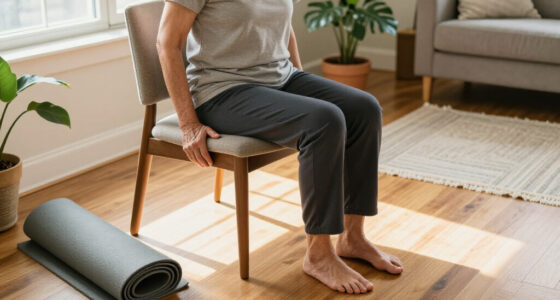
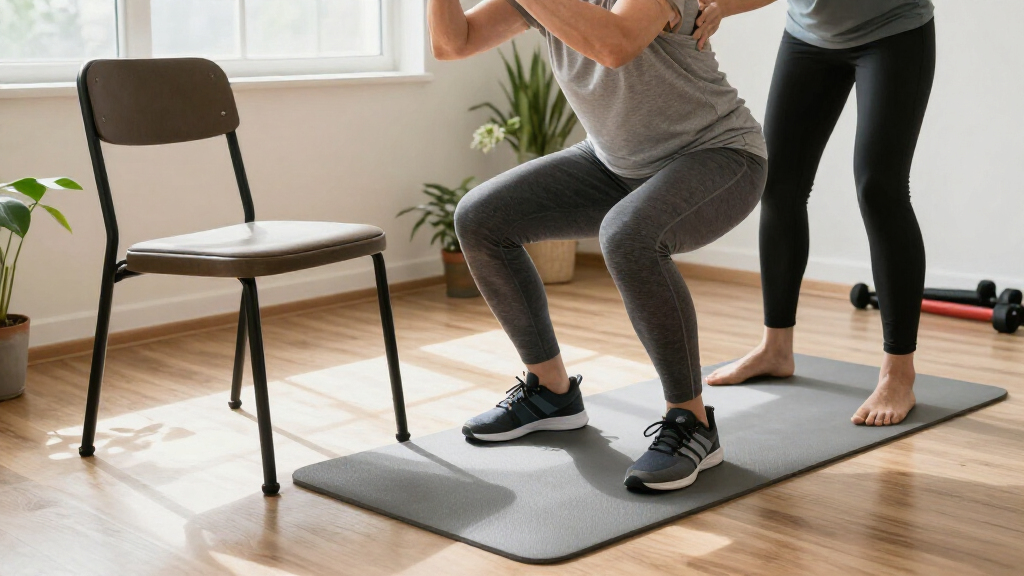
The second exercise is a slow sit-to-stand from a sturdy chair, performed without using the hands if possible. The aim is to control both standing and sitting while keeping weight toward the heels. The third is a heel-elevated deep-squat hold, using plates or wedges under the heels to make a deep position more accessible. The report suggests lowering the heel support gradually over time. It advises practicing the movements first, then, once technique is comfortable, aiming for three sets of each exercise, with one minute of work and one minute of rest.
Why Squat Heel Lift Can Matter
Knowing that more than one factor may be involved can affect how someone approaches the movement. If a person assumes the issue is only tight calves and focuses solely on ankle stretching, they may overlook hip mobility or strength, which the Fit&Well report identifies as another possible contributor. The article does not establish how common each cause is or say that any one exercise will address every case.
The three variations lower some of the demands of a regular bodyweight squat: straps assist balance, a chair makes the movement easier to control, and heel support changes the position from which a person practices depth. That offers readers a graded way to work on the movement rather than forcing a deeper squat. The report’s suggested progression is gradual, with less support or lower heel elevation as the person becomes more comfortable.
For readers, the practical point is to treat heel lift as a cue to examine movement and comfort, not as proof of a specific problem. The report gives general exercise guidance, not individualized coaching. People who experience pain, unusual symptoms or persistent difficulty may need advice from a qualified health or fitness professional rather than relying on a general article.
Products Worth Considering

Therabody Theragun Mini 3rd Generation Massage Gun, Black

Withings BPM Vision Blood Pressure Monitor with Wi-Fi and Bluetooth

Oral-B iO Series 3 Rechargeable Electric Toothbrush for Adults, Black, 3 Modes, 2 Brush Heads and Travel Case
As an affiliate, we earn on qualifying purchases.
The Report’s Three Squat Regressions
The Fit&Well article frames its recommendations around regressing an unweighted squat—using easier or supported versions of the movement before returning to a standard squat. It says repeated practice over a few weeks may help people improve strength through different phases of the movement. That timeframe is the article’s recommendation; the source does not provide study results or measured outcomes for the exercises.
For the strap-assisted version, the report advises standing with feet hip-width or slightly wider, toes turned slightly outward, and using the handles for support. For the chair version, it calls for a sturdy seat and a controlled descent. For the supported hold, it recommends keeping the knees apart, the back flat and the chest facing forward while settling into a comfortable position. In all three, it emphasizes gradual practice over rep targets at the start.
““For some, however, especially those with particularly weak or tight hips, the heels lifting could actually be a protective mechanism to safeguard the body from injury.””
— Fit&Well report
What the Exercise Guidance Cannot Show
The source does not identify the cause of heel lift for any particular person, provide a clinical assessment, or cite research comparing these three exercises. It also does not quantify how often the issue comes from ankle restriction versus hip factors, or how quickly an individual might progress. Its description of heel lifting as potentially protective is presented as a possibility, not a confirmed explanation in every case.
The report gives no specific guidance for people whose squats are painful or whose mobility is affected by an injury or health condition. Its suggested sets, work intervals and progression are general recommendations. Results and appropriate exercise choices may vary, and the article does not claim that the exercises will resolve every cause of heel lift.
How the Suggested Progression Works
The Fit&Well report recommends beginning with comfortable, supported practice and building confidence in the movement before aiming for its suggested three sets per exercise, with one minute of work and one minute of rest. It advises gradually reducing reliance on suspension straps and decreasing the height of heel supports as ability improves. For the chair variation, progression means controlling the descent until the person can lightly tap the seat rather than sitting fully.
The article does not announce a follow-up study or provide a formal timetable for results. Anyone using the guidance should progress according to comfort and control; if the movement causes pain or remains difficult, a qualified professional can help assess what is appropriate for them.
Key Questions
Why might my heels lift when I squat?
The Fit&Well report says limited ankle dorsiflexion, often associated with tight calves or ankle joints, may make a deep squat difficult with heels down. It also says hip mobility or strength could be involved for some people. The report cannot identify the cause for an individual.
Will calf stretches fix lifted heels?
Not necessarily. The report says ankle and calf stretches alone may not address the issue when hip mobility or strength is a factor. It does not claim that stretching is ineffective in every case.
Which three exercises does the report recommend?
It describes a suspension-trainer squat, a slow sit-to-stand from a chair, and a deep-squat hold with the heels supported on plates or wedges. These are presented as modified ways to practice the squat.
How should someone progress the exercises?
The report advises starting with technique and comfortable range rather than a rep target. It suggests reducing strap assistance, controlling the chair descent more slowly, and using progressively lower heel support as confidence and strength improve.
Source: fitandwell.com