
This checklist is for older adults and caregivers who want to make bedtime routines feel more comfortable and easier to navigate. It brings together six bedside product categories, from support when getting in and out of bed to items that can help organize the area around the bed.

Turn quiet afternoons into listening time
- Thousands of audiobooks, podcasts and originals
- Listen on your phone, tablet or Echo — also offline
- Cancel anytime
The checklist is organized by bedside role: each section covers one pick, explains what to consider when choosing that type of item, and offers a short verdict. Product names identify the picks; check the seller’s current listing and instructions for details about dimensions, materials, setup, and compatibility.
Use it as a decision guide, not a substitute for advice from a clinician or occupational therapist when an individual’s mobility or care needs call for it. Compare each item with the person’s bed, room layout, routines, and preferences. Prioritize the needs that matter most, then review fit and setup before buying.
Adjustable Bed Rail
A bed rail can be an important part of a bedtime setup when someone wants a handhold while moving between sitting and standing or changing position. The pick here is the Stander Wonder Pivot Bed Rail, Adjustable Safety Assist Railing with S. Its name identifies it as an adjustable safety assist railing, but the name alone does not establish how it attaches, what beds it fits, or how it should be used. Check the listing and instructions for those specifics before deciding whether it suits the person and bed.
A common buying mistake is treating any rail as a universal fit or assuming that a rail will address every transfer concern. Measure the bed and note its frame and mattress setup; then confirm compatibility with the manufacturer’s guidance. Consider where the person needs a handhold and whether the rail’s placement would interfere with getting into or out of bed. Review installation and use instructions with the person who will rely on it, and consult a care professional if you are unsure whether a rail is appropriate for their needs. Fit and safe use matter more than the category label.
What to look for:
- Bed-frame and mattress compatibility in the current listing
- Adjustment range and dimensions that suit the bed
- Installation steps and any stated attachment requirements
- Clear instructions for intended use and limitations
- Placement that works for the person’s usual bed entry and exit
Stander Wonder Pivot Bed Rail, Adjustable Safety Assist Railing with Swing Down

The Stander Wonder Pivot Bed Rail is an adjustable safety rail designed for adults, providing fall prevention and support for mobility. It features a pivoting design that swings down for easy access and bed making, and fits mattresses 8 to 12 inches thick.
Pros:
- Adjustable length and pivoting design for convenience and safety
- Passes ASTM safety standards for peace of mind
- Supports up to 300 lbs, suitable for various users
- Easy to attach to most traditional beds
Cons:
- Not compatible with adjustable or hospital beds
- Limited to mattresses 8-12 inches thick
- May require assistance for installation
Best for: someone seeking a bed rail to consider as a bedside handhold
Not ideal for: anyone whose bed setup or transfer needs have not been checked against the instructions
Bottom line: Confirm the rail’s fit, setup requirements, and suitability for the intended user before choosing it.
Bedside Fall Mat
A mat beside the bed is a category to consider when planning the floor area around a bed. The listed pick is the Bedside Fall Mat for Elderly – 2.5 Inch High-Density Foam, Rollable, N; its name specifies foam, a 2.5-inch height, and a rollable design. Confirm all details in the current product information, including the mat’s dimensions and care guidance. Consider how much floor space is available and where the person’s feet are likely to land when getting out of bed.
One common mistake is choosing by thickness alone without checking how the mat meets the floor, bed, and walking route. Measure the intended area and consider whether the mat’s edges or placement could affect movement around the room. Check the manufacturer’s information for the surface, handling, and cleaning instructions, and make sure the person can approach and leave the bed comfortably. A mat does not replace a broader review of fall risks or mobility needs. If the person uses a mobility aid or receives help with transfers, consider how the mat fits into that routine. Room layout and clear access should guide the choice alongside the listed dimensions.
What to look for:
- Mat dimensions compared with the available floor area
- The listed 2.5-inch height and how it meets the bed and floor
- Manufacturer details about the foam and rollable design
- Cleaning and care instructions
- A placement that leaves the route around the bed clear
Bedside Fall Mat for Elderly – 2.5 Inch High-Density Foam, Rollable, Non-Slip

This elderly fall prevention mat measures 71.6 x 24 inches with a 2.5-inch thickness, offering enhanced stability and shock absorption. Made from high-density foam with a waterproof cover and non-slip bumps, it is easy to clean, store, and versatile for various uses such as yoga, travel, and outdoor activities.
Pros:
- Provides excellent shock absorption and stability for elderly safety
- Removable waterproof cover makes cleaning easy
- Highly versatile for use as yoga or travel mat
Cons:
- Vacuum-packed, may need time to fully expand
- Requires heavy object to flatten when unrolled
- Size may be too large for small spaces
Best for: caregivers evaluating a mat for the bedside floor area
Not ideal for: rooms where the mat would obstruct the person’s usual route
Bottom line: Measure the floor area and review the mat’s edges, care guidance, and placement before purchase.
Motion Sensor Night Light
Lighting can help make nighttime routines easier to plan, especially when someone needs to locate a bedside area or walk through a room after dark. The pick is the JollyNet 2-Pack Motion Sensor Night Lights with 8 Colors, 3 Modes, and. The product name identifies a two-pack, motion sensor, eight colors, and three modes; confirm the complete listing for operating details and requirements. Think about where a light would be useful, such as near the bed or along a route the person regularly uses.
A common mistake is selecting a light based on its features without checking whether it suits the room and the person’s preferences. Review the instructions for sensor behavior, placement, power, and settings, rather than assuming how the light activates or how long it stays on. Consider whether the chosen location provides useful illumination without making the room uncomfortable for the person. If buying a two-pack, decide whether both lights have practical locations. Check that any controls or setup steps are manageable for the person or caregiver. Placement and usability are central: a light only helps a routine if it is located where needed and works as the user expects.
What to look for:
- Current listing details for the sensor and three modes
- Power source and setup requirements in the instructions
- Placement options near the bed and along the usual route
- Whether the available color and mode choices suit the user
- Two practical locations if using both lights in the pack
JollyNet 2-Pack Motion Sensor Night Lights with 8 Colors, 3 Modes, and Magnetic

These compact indoor night lights offer On, Off, and Auto modes, with motion detection up to approximately 3–5 m across a 110° area. They provide eight color options and four brightness levels, and can be repositioned using the magnetic mounting design.
Pros:
- Three operating modes, including motion-activated Auto mode
- Eight color options and four brightness settings
- Magnetic design allows flexible placement
Cons:
- Not waterproof
- Auto mode turns the light off about 15 seconds after motion stops
Best for: someone considering motion sensor lights for bedside routines
Not ideal for: anyone who has not checked sensor placement and operating requirements
Bottom line: Review the instructions and map useful locations before deciding whether this two-pack fits the room.
Waterproof Bed Pad
Bed protection is a practical consideration when selecting bedding for a senior’s room. The pick is named Waterproof Queen Mattress Topper – Cloud‑Like Soft Pillow Top Mattress. The name describes it as waterproof and queen-sized, while also using “pillow top” and “soft” wording; verify the actual construction and care instructions in the listing. Confirm the mattress dimensions before selecting any queen-labeled item, since the bed and the product need to match for a suitable fit.
A frequent buying mistake is assuming that a topper and a bed pad are interchangeable or that a product name answers questions about absorbency, waterproof layers, or laundering. Check the item’s full description for what it is designed to cover and how it should be maintained. Consider the mattress height and existing bedding so the chosen item can be placed and removed as needed. Look for explicit guidance on cleaning, drying, and any restrictions on use. If the goal is protecting only a particular area, check whether the item’s size and format meet that need. Care instructions and a verified mattress fit are essential details to review before adding it to the bed.
What to look for:
- Queen mattress dimensions and fit guidance
- The listing’s explanation of waterproof construction
- Whether the item is a topper, pad, or another bedding format
- Cleaning and drying instructions
- Compatibility with mattress height and existing bedding
Waterproof Queen Mattress Topper – Cloud‑Like Soft Pillow Top Mattress Pad

The BEDLORE queen mattress topper provides waterproof protection with a breathable TPU layer while delivering cloud-like comfort thanks to its 3D air fabric and quilted pillow top. It features a deep‑pocket, non‑slip elastic skirt that fits mattresses 6"–18" deep and is machine washable for easy care.
Pros:
- Waterproof and breathable protection keeps the mattress dry.
- Cloud‑like pillow top offers soft, supportive comfort.
- Deep pocket elastic skirt fits a wide range of mattress heights and stays in place.
Cons:
- May feel slightly warm for hot sleepers despite breathability.
Best for: someone looking for a waterproof queen bedding option
Not ideal for: anyone who needs a particular pad format without confirming the product details
Bottom line: Verify the item type, mattress fit, and care instructions against the bed’s needs.
Bed Wedge Pillow
A wedge pillow may be considered when a person wants an adjustable-angle support option as part of a bedtime setup. The listed pick is the Lunix LX13 Bed Wedge Pillow Post Surgery Set, Adjustable Angle, Should. Its name describes a bed wedge pillow set and mentions an adjustable angle; consult the complete listing for what is included, dimensions, adjustment details, and intended use. The words “post surgery” in the name are not a substitute for a clinician’s guidance about positioning or recovery.
A common mistake is assuming that a wedge will suit every body, bed, or comfort preference. Check the dimensions and how the set is adjusted, then consider whether the available space and the user’s preferred sleeping position are compatible. Review the care instructions and the full contents list so you know what the set includes. For someone recovering from surgery or managing a health concern, ask their care team whether this type of support and position is appropriate. Personal fit matters: an option that looks suitable in a listing may not feel comfortable or meet an individual’s care needs. Treat the product details and professional advice as inputs to the decision.
What to look for:
- Full set contents in the current listing
- Pillow dimensions and available adjustment details
- Care instructions for the included items
- A fit with the bed and the user’s preferred position
- Clinician guidance when considering it for recovery or a health need
Lunix LX13 Bed Wedge Pillow Post Surgery Set, Adjustable Angle, Shoulder

The Lunix LX13 Bed Wedge Pillow Set is designed for post-surgery recovery, allowing adjustable angles for comfortable sleeping and resting. It includes six foam modules, a gel pack, and compression bags, enabling customization for various needs and recovery stages.
Pros:
- Adjustable modules for personalized recovery angles
- Versatile use for sleeping, reading, or working in bed
- Includes storage bags for easy packing and storage
Cons:
- Requires 48-72 hours to expand after unpacking
- Foam takes up significant space when stored
- May need surgeon approval for specific angles
Best for: someone exploring an adjustable-angle wedge pillow set
Not ideal for: anyone using it for recovery without checking positioning guidance
Bottom line: Confirm dimensions and contents, and seek care-team input when health needs shape positioning.
Bedside Organizer Caddy
A bedside caddy can be useful to consider when the person wants frequently used items kept close at hand. The pick is the Bedside Caddy for Headboards and Bunk Beds. Its name indicates a caddy associated with headboards and bunk beds, but does not establish the exact attachment method, capacity, or which bed designs it fits. Check the current listing for dimensions, installation details, and any stated compatibility before choosing a location.
A common mistake is assuming that a caddy will fit any headboard or stay accessible in every bed arrangement. Measure the intended attachment area and compare it with the listed dimensions. Think about what the person plans to store and whether those items can be reached comfortably from bed. Review whether the caddy’s placement would interfere with getting in or out, changing bedding, or other bedside routines. Check the instructions for how it attaches and how to maintain it. If the bed has no suitable attachment point, the product name alone cannot confirm that another placement will work. Reach and fit should guide the decision, along with the user’s preference for what to keep nearby.
What to look for:
- Dimensions and attachment details in the listing
- Compatibility with the specific headboard or bunk bed
- A practical location within the user’s reach
- Capacity suited to the items the person plans to store
- Placement that does not interfere with bed access or bedding
Bedside Caddy for Headboards and Bunk Beds
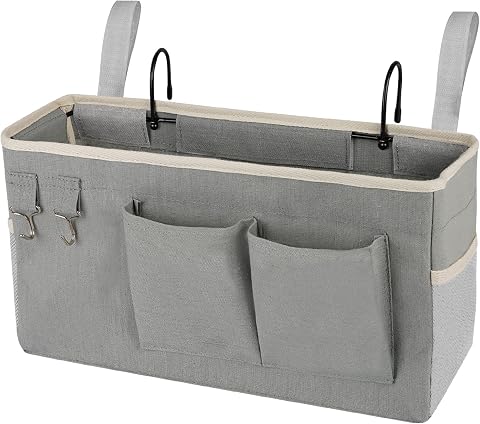
This bedside caddy organizer is designed to attach easily to headboards or bed rails, providing multiple pockets and hooks for storing books, remotes, water bottles, and other essentials. Made from durable canvas and iron, it offers stability and ample storage space, suitable for home, dorms, hospital beds, or camping.
Pros:
- Sturdy construction with fully covered metal frame for stability
- Multiple storage compartments and hooks for versatile use
- Easy to install on various bed types, including bunk beds and hospital beds
Cons:
- Limited to beds with headboards or rails less than 1.97 inches in diameter
- Size may be too small for larger items
- Requires assembly and hooking, which may be inconvenient for some users
Best for: someone seeking a caddy for a compatible headboard or bunk bed
Not ideal for: beds without a confirmed attachment point or reachable placement
Bottom line: Measure the bed and check the attachment instructions before deciding where this caddy belongs.
Start with the needs that affect bedtime most, then order purchases around fit and routine: first consider the bed rail or floor mat if transfers and bedside access are the priority, then lighting, bedding protection, positioning support, and storage as relevant. Confirm dimensions and compatibility before buying, and follow product instructions for setup and care.
Every bedroom and care routine is different, so it is fine to choose only the items that solve a real need. Use this checklist to compare the product details with the person’s preferences and the room itself. A few well-matched choices can make a more considered setup for bedtime.
Halloween Picks
halloween
As an affiliate, we earn on qualifying purchases.