
For moderate hearing loss, the Audien Atom One OTC Hearing Aids are my best overall pick in this lineup, while the Bigprot M802 stands out for rechargeable convenience and the Karthus rechargeable models for shoppers drawn to long battery-life claims. The main tradeoff is between compact designs and easier handling, along with simple amplification versus controls that let you adjust sound for different situations. Battery claims and noise-reduction labels do not tell the whole story; fit, speech clarity, return terms, and access to professional help matter too. I compare all 15 options by their stated features and the buyer needs they appear best suited to. Read on for the full breakdown and guidance on choosing a device that fits your hearing needs.

Turn quiet afternoons into listening time
- Thousands of audiobooks, podcasts and originals
- Listen on your phone, tablet or Echo — also offline
- Cancel anytime
Complete the kit


Key Takeaways
- Audien Atom One is my overall pick based on its distinct OTC positioning, but buyers should verify its fitting support and return policy before choosing it for moderate loss.
- Bigprot M802 and several Karthus listings emphasize rechargeable use; their battery claims are useful starting points, not a substitute for checking actual wear time and charging routines.
- Multiple products advertise noise cancellation or noise reduction, but those labels alone do not show how well speech remains clear in restaurants or group conversations.
- The lineup includes both specific model names and broad, generic product titles; shoppers should confirm the exact model, included accessories, and support terms before ordering.
- For moderate hearing loss, a comfortable fit and access to adjustment or professional guidance may matter more than extra volume steps or a headline battery-life figure.
| OTC Hearing Aids for Seniors with Noise Cancelling and 100 Hours Battery Life | 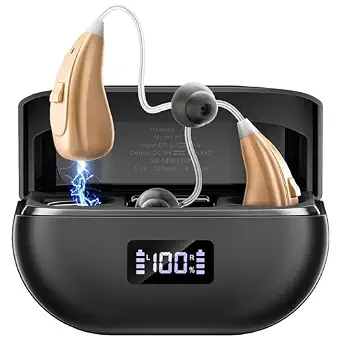 | Best Overall for Long Wear Between Charges | Fitting style: In-ear | Processing: 16-channel | Noise cancellation: Yes | VIEW ON AMAZON | See Our Full Breakdown |
| Hearing Aids for Seniors, Rechargeable Noise Cancelling Amplifiers with 48+ Hour Battery & Charging Case, Blue/Red |  | Best for First-Time Users | Battery life: 48+ hours | Charging case backup: Over 110 hours | Weight: 2 g | VIEW ON AMAZON | See Our Full Breakdown |
| Hearing Aids for Seniors Moderate Loss Noise Cancel Volume Adjustable |  | Best for Straightforward Volume Adjustment | Intended hearing loss: Moderate | Power source: Battery powered | Battery type: Lithium-ion | VIEW ON AMAZON | See Our Full Breakdown |
| Karthus OTC Hearing Aids for Seniors, Rechargeable with Noise Reduction |  | Best Behind-Ear Fit with Listening Modes | Fitting style: Behind-ear | Intended hearing loss: Mild to moderate | Hearing modes: 2: Quiet Mode and Noise Mode | VIEW ON AMAZON | See Our Full Breakdown |
| Rechargeable Behind-The-Ear Hearing Aids for Seniors with Noise Cancellation |  | Best for Severe-Loss Positioning and Physical Controls | Fitting style: Behind-ear | Stated audience: Severe hearing loss | Weight: 5.5 g | VIEW ON AMAZON | See Our Full Breakdown |
| Bigprot M802 Rechargeable Hearing Aids for Seniors with Noise Cancelling |  | Best for Simple Controls and Long Case Runtime | Model: HADM802-White | Processor: 16-channel digital chip | Noise control: AI noise cancellation | VIEW ON AMAZON | See Our Full Breakdown |
| Rechargeable Hearing Aids for Seniors – 20 Hour Battery |  | Best for Beginner-Friendly Everyday Wear | Suitable hearing loss: Mild to moderate | Design: Lightweight behind-the-ear | Battery life: 20 hours | VIEW ON AMAZON | See Our Full Breakdown |
| OTC Hearing Aids for Seniors with Hearing Loss |  | Best for Bluetooth Calls and Media | Product type: OTC hearing aids | Battery life per charge: 12–15 hours | Additional case charges: Three to four | VIEW ON AMAZON | See Our Full Breakdown |
| Karthus Rechargeable Hearing Aids for Seniors, Noise Cancelling, 100h Battery Life, Ice Silver |  | Best for Long Wear Between Charges | Suitable hearing loss: Mild to moderate | Processor: 16-channel DSP | Battery life per charge: Up to 30 hours | VIEW ON AMAZON | See Our Full Breakdown |
| Hearing Aids for Seniors & Adults, 5-Level Volume, 100-Hour Battery Life |  | Best for Simple Volume Memory | Technology: 16-channel chip with noise-canceling technology | Amplification: Up to 40 dB ±5 dB | Volume levels: Five | VIEW ON AMAZON | See Our Full Breakdown |
| Hearing Aids for Seniors Rechargeable 24H Battery |  | Best for Long Daily Wear | Fit: Behind-the-ear | Battery life: 24 hours per charge | Charging time: 2 hours | VIEW ON AMAZON | See Our Full Breakdown |
| Flaygo Rechargeable Hearing Aids for Seniors with Noise Reduction | 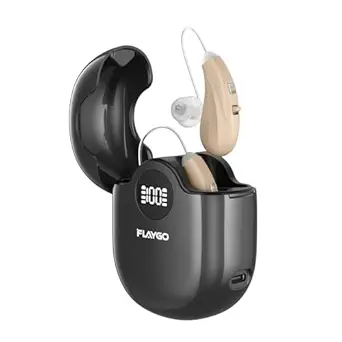 | Best for Simple, Lightweight Wear | Fit: Behind-the-ear | Weight: 3.5 g | Sound processing: 16-channel digital chip | VIEW ON AMAZON | See Our Full Breakdown |
| Audien Atom One OTC Hearing Aids | 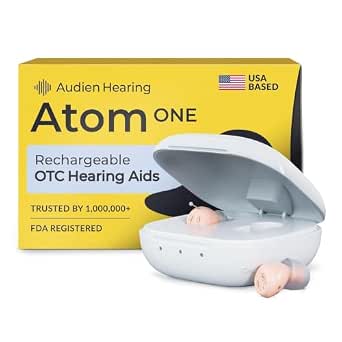 | Best for App-Free In-Ear Controls | Fit: In-ear | Intended hearing range: Mild to moderate hearing loss | Controls: Analog dials for volume and frequency | VIEW ON AMAZON | See Our Full Breakdown |
| Rechargeable Hearing Aids for Seniors and Adults with Noise Reduction |  | Best for Listening Modes | Fit: Behind-the-ear | Battery life: Up to 20 hours per charge | Charging time: 2 hours | VIEW ON AMAZON | See Our Full Breakdown |
| Hearing Aids for Seniors, Rechargeable with Noise Cancellation, 5-Level Volume Control, OTC Hearing Amplifier for Moderate Hearing Loss | 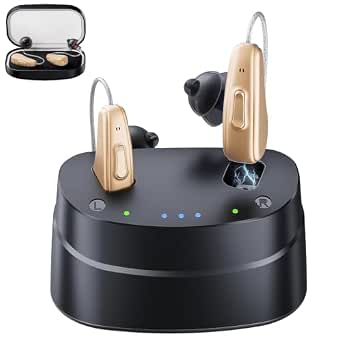 | Best for Five-Step Volume Adjustment | Fit: In-ear | Intended hearing range: Moderate hearing loss | Battery life: Up to 25 hours per charge | VIEW ON AMAZON | See Our Full Breakdown |
| hearing aids for moderate hearing loss | Battery life | Controls |
|---|---|---|
| OTC Hearing Aids for Seniors w | 25+ hours per charge; 100+ hours with charging case | One-button |
| Hearing Aids for Seniors | 48+ hours | One-button |
| Hearing Aids for Seniors Moder | — | — |
| Karthus OTC Hearing Aids for S | Up to 30 hours per charge; 100 hours with case | — |
| Rechargeable Behind-The-Ear He | Up to 25 hours | Slide switch and continuous volume knob |
| Bigprot M802 Rechargeable Hear | — | One-button interface |
| Rechargeable Hearing Aids for | 20 hours | Large volume buttons; no app required |
| OTC Hearing Aids for Seniors w | — | — |
| Karthus Rechargeable Hearing A | — | — |
| Hearing Aids for Seniors & Adu | — | — |
| Hearing Aids for Seniors Recha | 24 hours per charge | Large buttons; no app required |
| Flaygo Rechargeable Hearing Ai | — | One-button control |
| Audien Atom One OTC Hearing Ai | Up to 24 hours | Analog dials for volume and frequency |
| Rechargeable Hearing Aids for | Up to 20 hours per charge | Button control with volume adjustment |
| Hearing Aids for Seniors | Up to 25 hours per charge | — |
More Details on Our Top Picks
OTC Hearing Aids for Seniors with Noise Cancelling and 100 Hours Battery Life
For a buyer with moderate hearing loss who wants uncomplicated daily use, this model combines 16-channel processing with noise cancellation and a particularly generous stated runtime: more than 25 hours per charge and over 100 hours with the case. That combination may reduce charging interruptions while giving speech-focused processing more room to distinguish sounds than the simpler specifications provided for the Blue/Red rechargeable amplifiers. Its one-button control and automatic memory keep operation straightforward, though they also limit how much the wearer can tailor sound for different situations. At 3 grams per aid, the in-ear design is light, but comfort still depends on ear shape. I rank it ahead of the Karthus behind-ear model for its stated channel processing and longer per-charge runtime; choose Karthus instead if an over-ear fit and two listening modes better match your needs.
Pros:- 16-channel processing offers more specified sound handling than several basic-control options in this group.
- Over 25 hours per charge and more than 100 hours with the case can support extended daily use.
- Three-gram in-ear aids are lightweight for discreet wear.
- One-button operation and automatic memory keep routine use simple.
Cons:- Limited controls may not provide enough adjustment for changing listening environments.
- Extended runtime depends on keeping the charging case available.
- In-ear fit may be uncomfortable or insecure for some ear shapes.
Best for: Adults with moderate hearing loss who want a lightweight in-ear aid, basic controls, and fewer charging interruptions.
Not ideal for: Wearers who need detailed manual tuning or struggle to find comfortable in-ear fittings; its one-button controls and fit may not suit them.
- Fitting style:In-ear
- Processing:16-channel
- Noise cancellation:Yes
- Battery life:25+ hours per charge; 100+ hours with charging case
- Battery type:Lithium-ion, rechargeable
- Weight:3 g each
- Controls:One-button
- Material:Medical-grade silicone
Our verdict“Choose this for lightweight everyday wear and long case-supported runtime if basic controls provide enough adjustment for your moderate hearing loss.”
Hearing Aids for Seniors, Rechargeable Noise Cancelling Amplifiers with 48+ Hour Battery & Charging Case, Blue/Red
This pair is aimed at people who want to start with simple amplification rather than a learning curve: one-button operation, automatic noise reduction, and a 2-gram miniaturized design keep daily handling straightforward. Its stated 48-plus-hour battery life and case backup of over 110 hours are useful for users who would rather charge less often. Compared with the 16-channel OTC model, however, the product data gives less detail about sound processing and adjustment, so I would favor that alternative if specified channel control matters to your choice. Noise reduction may help in everyday settings, but the listing cautions that very noisy places can remain challenging. The blue/red color coding may also help identify left and right aids, though it is less neutral-looking than the blackish-silver in-ear option.
Pros:- One-button operation is approachable for users who want few controls.
- At 2 g, the aids are especially light among the products with stated weights.
- 48+ hours of stated battery life with over 110 hours of case backup reduces charging frequency.
- Automatic noise reduction avoids requiring the wearer to manage multiple settings.
Cons:- Basic volume control offers little scope for personal sound adjustment.
- Noise reduction may not be enough for extremely noisy environments.
- Daily use still depends on keeping the rechargeable aids charged.
Best for: First-time adult users with moderate hearing loss who prioritize light, simple-to-operate aids and long case-supported battery life.
Not ideal for: Listeners who need extensive sound customization or regularly need help following speech in very noisy settings.
- Battery life:48+ hours
- Charging case backup:Over 110 hours
- Weight:2 g
- Color:Blue/red
- Controls:One-button
- Noise reduction:Automatic
- Power:Rechargeable
Our verdict“Pick this for a simple, lightweight introduction to amplification, but choose a more adjustable model if your listening needs vary widely.”
Hearing Aids for Seniors Moderate Loss Noise Cancel Volume Adjustable
The clearest reason to choose this model is its focus on moderate hearing loss and adjustable volume without adding app-based setup or complex controls. Its one-touch operation and automatic power on/off make it an approachable daily option for someone who wants to adjust amplification directly. The stated runtime is up to 80 hours, although the supplied specs do not clarify whether that figure is per charge or includes a case, so I would verify the usage details before relying on it for travel. Compared with the Karthus behind-ear aid, this product has less fit and mode information, while Karthus specifies a behind-ear style and two modes. It may still suit buyers who prefer a skin-tone style and basic volume adjustment, but limited sound-quality information makes it harder to judge how precisely it handles speech.
Pros:- Designed specifically for moderate hearing loss, according to the product description.
- Adjustable volume gives the wearer direct control over amplification.
- One-touch control and automatic power on/off simplify routine use.
- Rechargeable battery is listed with up to 80 hours of use.
Cons:- The battery-life listing does not explain whether the stated 80 hours is per charge or includes a case.
- No app support or advanced customization is specified.
- Sound-quality and fitting details are limited in the provided product data.
Best for: Seniors with moderate hearing loss who want basic volume adjustment and one-touch operation without app setup.
Not ideal for: Buyers who need clearly documented sound processing, a stated fitting style, or detailed guidance on runtime per charge.
- Intended hearing loss:Moderate
- Power source:Battery powered
- Battery type:Lithium-ion
- Battery voltage:3 V
- Battery count:1
- Listed use time:Up to 80 hours; charge basis not specified
- Dimensions:1.5 in L x 0.78 in W
- Style:Skin tone
Our verdict“Choose this if direct volume control and uncomplicated operation matter more than detailed sound specifications or advanced fitting options.”
Karthus OTC Hearing Aids for Seniors, Rechargeable with Noise Reduction
The Karthus is the most clearly differentiated fit in this group: its behind-ear design keeps the main aid off the ear canal, which may appeal to buyers who find in-ear devices uncomfortable. Two listening modes—Quiet and Noise—give it a simple way to adapt between calmer rooms and noisier surroundings. Compared with the one-button in-ear 16-channel model, Karthus offers more explicit mode selection but does not list channel processing or app-based tuning. Its stated runtime reaches 30 hours per charge and 100 hours with the case, below the other model’s 25-plus hours per charge and 100-plus hours with case, though Karthus also specifies a 15-minute quick-charge feature. The product is described for mild to moderate loss, so buyers should not treat it as a fit for more severe needs.
Pros:- Behind-ear styling offers an alternative to the in-ear designs in this roundup.
- Two named listening modes let users switch between quieter and noisier settings.
- Up to 30 hours per charge and 100 hours with the case support regular use.
- A stated 15-minute quick-charge feature can help when time is limited.
Cons:- No wireless connectivity or app control is specified.
- The stated mild-to-moderate range may not suit people with more severe loss.
- It requires the charging station or case to recharge.
Best for: Adults with mild to moderate hearing loss who prefer a behind-ear fit and want a basic choice between quiet and noise modes.
Not ideal for: People seeking app control, wireless connectivity, or a product described for severe hearing loss.
- Fitting style:Behind-ear
- Intended hearing loss:Mild to moderate
- Hearing modes:2: Quiet Mode and Noise Mode
- Battery type:Lithium-ion
- Battery voltage:3.7 V
- Battery life:Up to 30 hours per charge; 100 hours with case
- Charging time:15 minutes for hours of use
- Control:Button
- Color:Matte black
Our verdict“Choose Karthus if you want a behind-ear aid with two simple listening modes and your hearing needs fall within its mild-to-moderate range.”
Rechargeable Behind-The-Ear Hearing Aids for Seniors with Noise Cancellation
This is the only option here explicitly described for severe hearing loss, making it a distinct candidate for buyers whose needs may exceed the moderate-loss focus of the other entries. Its behind-the-ear hooks and physical slide switch and continuous volume knob may be easier to handle than the single-button controls on the Karthus or Blue/Red models. The tradeoff is a shorter stated runtime: up to 25 hours, compared with Karthus’s up to 30 hours per charge and case-supported 100 hours. Dual charging options and a case that charges both aids up to four times provide practical backup, but the listing warns of possible operating noise and an adjustment period. Since the product’s stated target includes severe loss, buyers with moderate loss should confirm suitability with a hearing-care professional rather than assume stronger amplification is automatically a better match.
Pros:- Behind-ear hooks provide a different fit from the in-ear options in this roundup.
- A slide switch and continuous volume knob offer tactile adjustment without an app.
- Charging cable and case provide two charging options.
- The case can charge both aids up to four times.
Cons:- Up to 25 hours per charge is less than the stated per-charge runtime of the Karthus behind-ear model.
- The listing notes possible operating noise.
- New wearers may need an adaptation period.
Best for: Adults described as having severe hearing loss who prefer behind-ear hooks and tactile, physical volume controls.
Not ideal for: Buyers seeking a discreet in-ear fit, the longest per-charge runtime, or a product specifically characterized for moderate loss.
- Fitting style:Behind-ear
- Stated audience:Severe hearing loss
- Weight:5.5 g
- Battery life:Up to 25 hours
- Charging options:Charging cable and case
- Case capacity:Charges both aids up to 4 times
- Controls:Slide switch and continuous volume knob
- Noise reduction:Double noise cancellation
Our verdict“Consider this for its stated severe-loss audience and physical controls, but confirm that its amplification suits your hearing profile before choosing it for moderate loss.”
Bigprot M802 Rechargeable Hearing Aids for Seniors with Noise Cancelling
The Bigprot M802 suits buyers who want preset listening modes and simple physical controls rather than app-based adjustments. Its 16-channel chip and AI noise cancellation are intended to make speech easier to follow amid background sound, while Quiet, Social, and Outdoor modes offer a straightforward way to adapt. The charging case provides up to 120 hours of runtime, the longest stated case-supported figure among these five picks. Compared with the Karthus Rechargeable Hearing Aids, which give 30 hours per charge and seven volume levels, the Bigprot emphasizes case capacity and three scene presets over detailed volume choices. The tradeoff is limited fine-tuning: there is no stated app or Bluetooth support, and the exact unit weight is not provided. I’d choose it for uncomplicated daily use, not wireless listening or highly customized settings.
Pros:- Three named modes make basic listening adjustments easy without an app.
- Charging case provides up to 120 hours of stated runtime.
- Large tactile buttons support straightforward operation.
- Six pairs of ear tips provide several fit options.
Cons:- Only three preset modes are listed, with no custom fine-tuning described.
- Bluetooth and smartphone integration are not specified.
- Exact hearing-aid weight is not provided.
Best for: Seniors who want tactile, app-free controls, a few environment presets, and extended power from a portable charging case.
Not ideal for: Buyers who need Bluetooth streaming, smartphone adjustments, or more detailed personalization than three preset modes.
- Model:HADM802-White
- Processor:16-channel digital chip
- Noise control:AI noise cancellation
- Modes:Quiet, Social, Outdoor
- Stated runtime:Up to 120 hours
- Charging:USB-C via portable charging case
- Controls:One-button interface
- Included ear tips:Six pairs in S, M, and L
Our verdict“Choose the Bigprot M802 if simple controls and long case-supported runtime matter more than Bluetooth or fine-grained adjustments.”
Rechargeable Hearing Aids for Seniors – 20 Hour Battery
This pair stands out for a low-fuss setup: large volume buttons, an LED battery indicator, and no app requirement make routine use less complicated. The product is specified for mild to moderate hearing loss, so it is a relevant option for readers seeking everyday amplification rather than a device intended for severe loss. Its stated 20-hour battery life is clear, though less extensive than the Bigprot M802 with its case-supported 120-hour figure or the Karthus Rechargeable Hearing Aids at 30 hours per charge. Six adjustable earbud sizes give buyers room to work toward a comfortable fit, and the listed 15–20 dB noise reduction may help reduce background sound. The main tradeoff is a simpler feature set: no Bluetooth or scene modes are specified, and the product description does not provide a custom fitting process.
Pros:- Large buttons and app-free operation keep everyday controls simple.
- LED indicator provides a visible battery-level cue.
- Six earbud sizes offer several fit choices.
- Noise reduction is specified at 15–20 dB.
Cons:- The stated 20-hour battery life is shorter than the Bigprot M802’s case-supported runtime.
- Bluetooth connectivity and environment-specific modes are not listed.
- The description limits its intended use to mild to moderate hearing loss.
Best for: First-time hearing-aid buyers with mild to moderate hearing loss who prefer physical volume controls and a clear battery indicator.
Not ideal for: People seeking Bluetooth streaming, multiple listening scenes, or a stated battery life beyond 20 hours per charge.
- Suitable hearing loss:Mild to moderate
- Design:Lightweight behind-the-ear
- Battery life:20 hours
- Rechargeable:Yes
- Noise reduction:15–20 dB
- Earbud options:Six adjustable sizes
- Display:LED battery-level indicator
- Controls:Large volume buttons; no app required
Our verdict“Pick this model for straightforward daily amplification and easy physical controls, but choose another option if wireless features or longer stated runtime are priorities.”
OTC Hearing Aids for Seniors with Hearing Loss
Among these five options, this is the one to look at if you want hearing support alongside Bluetooth for calls and media. It automatically switches between Bluetooth and hearing-aid modes, which can reduce the need to change settings manually when moving between listening tasks. Indoor, Outdoor, and Noise Reduction scenes offer more named environment choices than the two modes listed for the Karthus Rechargeable Hearing Aids. Its charging case supplies three to four additional charges, though the stated 12–15 hours per charge is shorter than the 20 hours listed for the Rechargeable Hearing Aids for Seniors – 20 Hour Battery. The tradeoff is that Bluetooth requires initial pairing, and this is an OTC device rather than a custom-fitted solution. Buyers should also note that the provided details do not specify channel count or a precise hearing-loss range.
Pros:- Bluetooth supports calls and media in addition to hearing-aid mode.
- Automatic switching reduces manual mode changes between Bluetooth and hearing use.
- Three scene modes cover indoor, outdoor, and noise-reduction settings.
- Charging case provides three to four additional charges and has a power indicator.
Cons:- Bluetooth requires initial pairing.
- The 12–15-hour per-charge runtime is shorter than the 20-hour model in this lineup.
- OTC design is not custom-fitted, and the supplied details do not state a specific hearing-loss range.
Best for: Adults who want an OTC option that can handle calls and media over Bluetooth as well as everyday hearing-aid use.
Not ideal for: Buyers who want a custom-fitted device, dislike pairing steps, or need a clearly stated hearing-loss range and technical amplification details.
- Product type:OTC hearing aids
- Battery life per charge:12–15 hours
- Additional case charges:Three to four
- Connectivity:Bluetooth and hearing-aid mode
- Scene modes:Indoor, Outdoor, Noise Reduction
- Mode switching:Automatic between hearing and Bluetooth modes
- Charging-case indicator:Power indicator included
Our verdict“Choose this OTC model if Bluetooth calls and media are a priority and you are comfortable with pairing and a non-custom fit.”
Karthus Rechargeable Hearing Aids for Seniors, Noise Cancelling, 100h Battery Life, Ice Silver
The Karthus is the strongest fit here for buyers who value long use per charge over wireless extras: it lists up to 30 hours from the hearing aids, plus up to 100 hours with the case. Its 16-channel DSP and Quiet and Noise modes aim to make speech clearer when background sound changes, while seven volume levels give more direct adjustment than the three presets on the Bigprot M802. A 15-minute quick charge is stated to provide about six hours of use, a practical backup when the devices run low. The 0.1-ounce RIC design, soft tulip tips, and glasses-friendly fit are also distinct advantages for extended wear. The tradeoff is no Bluetooth or smartphone app, unlike the OTC Hearing Aids for Seniors with Hearing Loss. Fit matters too; the listed features do not replace individualized fitting or professional guidance.
Pros:- Up to 30 hours of use per charge, with up to 100 hours stated with the case.
- Seven volume levels provide more adjustment steps than the Bigprot M802’s three modes.
- A 15-minute quick charge is stated to provide about six hours of use.
- Lightweight RIC design and glasses-friendly fit support extended wear.
Cons:- Bluetooth and smartphone app support are not included in the listed features.
- Not intended for severe or profound hearing loss.
- Performance depends on selecting and inserting ear tips correctly.
Best for: Adults with mild to moderate hearing loss who want long per-charge use, quick charging, and physical volume adjustments.
Not ideal for: People who need Bluetooth streaming, app-based tuning, or a device intended for severe or profound hearing loss.
- Suitable hearing loss:Mild to moderate
- Processor:16-channel DSP
- Battery life per charge:Up to 30 hours
- Battery life with case:Up to 100 hours
- Quick charge:15 minutes for about six hours of use
- Volume levels:Seven
- Modes:Quiet, Noise
- Weight and design:0.1 oz; RIC behind-the-ear design
Our verdict“Choose the Karthus for long per-charge runtime, quick charging, and more volume steps, provided Bluetooth is not a requirement.”
Hearing Aids for Seniors & Adults, 5-Level Volume, 100-Hour Battery Life
This model takes a straightforward approach for buyers who want a few repeatable volume choices rather than multiple scene settings or phone features. Its five volume levels and memory function are meant to make it easier to return to a preferred setting, while the 16-channel chip and noise-canceling technology target clearer everyday amplification. The 25-hour per-charge figure is longer than the Rechargeable Hearing Aids for Seniors – 20 Hour Battery, and the case supports up to 100 hours in total. By comparison, the Karthus Rechargeable Hearing Aids offer seven volume levels and a stated quick-charge feature, giving them more adjustment steps and charging flexibility. Here, the listed amplification range is up to 40 dB ±5 dB, so it may not suit every level of hearing need. Fit also takes some adjustment, and water resistance is not specified.
Pros:- Five volume levels provide straightforward adjustment without an app.
- Memory function is designed to retain a preferred volume setting.
- Up to 25 hours per charge and up to 100 hours with the case are stated.
- Multiple soft silicone ear-tip sizes support fit adjustment.
Cons:- Five volume levels offer fewer adjustment steps than the Karthus model’s seven.
- The stated amplification range may not suit every degree of hearing loss.
- Waterproof or sweat-resistant protection is not specified.
Best for: Adults seeking rechargeable everyday amplification with a small set of volume levels and memory for a familiar setting.
Not ideal for: Buyers who want Bluetooth, named environment modes, a quick-charge specification, or confirmation of water and sweat resistance.
- Technology:16-channel chip with noise-canceling technology
- Amplification:Up to 40 dB ±5 dB
- Volume levels:Five
- Volume memory:Yes
- Battery life per charge:25 hours
- Battery life with case:Up to 100 hours
- Technology and fit:RIC technology; soft silicone ear tips in multiple sizes
Our verdict“Pick this model if you want simple volume control with a remembered setting and case-supported runtime, rather than Bluetooth or extensive customization.”
Hearing Aids for Seniors Rechargeable 24H Battery
For someone with mild to moderate hearing loss who wants a full day between charges, this behind-the-ear pair offers up to 24 hours per charge and another 100 hours from its case. That gives it an endurance advantage over the Rechargeable Hearing Aids for Seniors and Adults with Noise Reduction, which list up to 20 hours per charge. Its slim, lightweight design and six pairs of adjustable earbuds give buyers room to tune the fit, while large buttons avoid app setup. The stated 15–20dB noise reduction may help with everyday listening, but the listing does not describe detailed environment controls. Buyers should also expect some fit adjustment, and this model is not intended for severe hearing loss.
Pros:- Up to 24 hours of use per charge, plus 100 hours with the charging case
- Slim, lightweight behind-the-ear design
- Large physical buttons work without an app
- Six pairs of adjustable earbuds offer fit options
Cons:- Designed for mild to moderate hearing loss, not severe loss
- May take adjustment to find a comfortable, secure fit
- Noise reduction is specified, but advanced mode controls are not described
Best for: Adults with mild to moderate hearing loss who want simple physical controls and long daily use without frequent charging.
Not ideal for: People with severe hearing loss, or buyers who need detailed listening-mode controls and a highly individualized fitting process.
- Fit:Behind-the-ear
- Battery life:24 hours per charge
- Charging time:2 hours
- Additional battery life:100 hours with case
- Earbud options:6 pairs of adjustable earbuds
- Noise reduction:15–20dB
- Controls:Large buttons; no app required
- Design:Ultra-slim, ultra-lightweight
Our verdict“Choose this pair if you want straightforward controls and longer per-charge use than the 20-hour Rechargeable Hearing Aids for Seniors and Adults with Noise Reduction.”
Flaygo Rechargeable Hearing Aids for Seniors with Noise Reduction
Flaygo is a good match for buyers who want a lightweight behind-the-ear fit and simple operation rather than a large set of adjustments. At 3.5 g, it is notably light, and its one-button controls offer four volume levels without requiring an app. The 16-channel digital chip, noise reduction, and whistling suppression give it more explicitly described sound processing than the Audien Atom One, which has no listed noise control. The tradeoff is limited fine-tuning: four volume levels may not give every person with moderate hearing loss enough control, and the listing does not specify a per-charge listening duration. USB-C charging takes two hours, but the stated 80-hour figure is standby time, not continuous use. The behind-the-ear shape is also more visible than an in-ear option.
Pros:- Light 3.5 g behind-the-ear design
- One-button operation with four volume levels
- Noise reduction and whistling suppression are specified
- USB-C charging takes two hours
Cons:- Four volume levels may not provide enough adjustment for some users
- 80 hours refers to standby time; listening time per charge is not specified
- Behind-the-ear placement is more visible than the Audien Atom One in-ear design
Best for: Adults with mild to moderate hearing loss who prefer lightweight behind-the-ear devices, physical controls, and basic noise and feedback management.
Not ideal for: Buyers who need many volume steps, a stated all-day listening time, or a device that sits entirely inside the ear.
- Fit:Behind-the-ear
- Weight:3.5 g
- Sound processing:16-channel digital chip
- Noise control:Active noise cancellation and whistling suppression
- Volume settings:4 levels
- Controls:One-button control
- Charging time:2 hours
- Standby time:Up to 80 hours
- Battery:Lithium-ion; USB-C charging
Our verdict“Pick Flaygo if low weight and straightforward noise management matter more than extensive adjustment or a clearly stated listening time.”
Audien Atom One OTC Hearing Aids
The Audien Atom One suits buyers who value a discreet in-ear design and direct, tactile adjustment. Its analog dials control volume and frequency, so users can make changes on the device rather than navigating app menus. That makes it distinct from the behind-the-ear Flaygo, whose controls are simpler but limited to four volume levels. Audien is rechargeable for up to 24 hours and includes expert setup support and multiple ear dome sizes, which may help buyers work toward a more comfortable fit. The main compromise for moderate hearing loss is the lack of listed noise control: background sound may be harder to manage than with the noise-reducing Flaygo or five-level in-ear model. It is intended for mild to moderate loss, not severe hearing loss.
Pros:- Discreet in-ear fit
- Analog dials allow manual volume and frequency adjustment
- Rechargeable battery provides up to 24 hours of use
- Expert-guided setup and multiple ear dome sizes are included
Cons:- No noise control is listed, unlike Flaygo and the five-level in-ear option
- Requires charging every 24 hours
- Designed for mild to moderate hearing loss, not severe cases
Best for: Adults with mild to moderate hearing loss who want a discreet in-ear device, manual sound adjustments, and guided setup without app-based controls.
Not ideal for: People who often listen in noisy settings and want stated noise reduction, or anyone with severe hearing loss.
- Fit:In-ear
- Intended hearing range:Mild to moderate hearing loss
- Controls:Analog dials for volume and frequency
- Battery life:Up to 24 hours
- Battery type:Lithium-ion rechargeable
- Noise control:None listed
- Included fit options:Multiple ear dome sizes
- Setup support:Expert-guided setup
Our verdict“Choose the Atom One for discreet wear and hands-on sound adjustment, but favor a noise-reducing model if background listening is a priority.”
Rechargeable Hearing Aids for Seniors and Adults with Noise Reduction
This pair is the more adaptable choice for buyers who want multiple listening modes alongside noise reduction. Those options may be useful when moving between everyday environments, although the product details do not identify the modes or explain how they change sound. Its behind-the-ear design uses button controls and provides up to 20 hours per charge after a two-hour charge. That is less per-charge runtime than the 24-hour Hearing Aids for Seniors Rechargeable 24H Battery, but the emphasis here is on listening modes rather than maximum endurance. The stated item weight of 7.36 ounces may also make it feel less discreet or comfortable for extended wear than Flaygo’s 3.5 g design. Buyers should check fit expectations and remember that ongoing charging and care are part of ownership.
Pros:- Noise reduction and multiple listening modes are specified
- Up to 20 hours of use from a two-hour charge
- Button controls provide direct operation
- Rechargeable built-in lithium-ion battery
Cons:- Listed item weight is 7.36 ounces, considerably heavier than Flaygo’s stated 3.5 g
- Provides less per-charge use than the 24-hour rechargeable model
- Details about software updates and the listening modes are limited
Best for: Adults with mild to moderate hearing loss who prefer a behind-the-ear device and want noise reduction with more than one listening mode.
Not ideal for: People who prioritize a lightweight, discreet fit or longer per-charge runtime, or buyers who need clear documentation of software support and mode behavior.
- Fit:Behind-the-ear
- Battery life:Up to 20 hours per charge
- Charging time:2 hours
- Battery:Built-in rechargeable lithium-ion
- Noise control:Active noise cancellation
- Listening modes:Multiple modes; specific modes not listed
- Controls:Button control with volume adjustment
- Listed item weight:7.36 ounces
- Materials:Plastic and silicone
Our verdict“Choose this model if listening modes are your priority, but compare its stated weight and shorter runtime with lighter or longer-lasting alternatives.”
Hearing Aids for Seniors, Rechargeable with Noise Cancellation, 5-Level Volume Control, OTC Hearing Amplifier for Moderate Hearing Loss
For moderate hearing loss, this in-ear model makes a stronger case for adjustment than the Audien Atom One: its five volume levels provide clear steps, while Audien relies on analog dials and does not list noise control. The device also specifies 43dB ±5dB gain and active noise reduction, giving buyers more concrete information about amplification and background-noise handling. Up to 25 hours per charge, with up to 100 hours of total listening time using the case, supports extended use between outlet visits. The tradeoff is manual button operation, which may be less convenient for people who prefer dial adjustments or app controls. Its stated use is limited to moderate hearing loss, and details about software updates and other customization are sparse.
Pros:- Five volume levels allow straightforward manual adjustment
- Up to 25 hours per charge and up to 100 hours with the case
- Active noise reduction is specified
- Multiple ear tip sizes support fit adjustment
Cons:- Intended for moderate hearing loss, not severe cases
- Button-only operation may not suit buyers who prefer dial or app controls
- Software support and additional customization details are not provided
Best for: Adults with moderate hearing loss who want an in-ear fit, five manual volume steps, and a charging case for extended use.
Not ideal for: People with severe hearing loss, buyers who prefer app-based or dial controls, or users who need detailed information about advanced customization.
- Fit:In-ear
- Intended hearing range:Moderate hearing loss
- Battery life:Up to 25 hours per charge
- Total listening time:Up to 100 hours with charging case
- Volume control:5-level button control
- Gain:43dB ±5dB
- Noise control:Active noise reduction
- Color:Beige
- Fit options:Multiple ear tip sizes
Our verdict“Choose this model over the Audien Atom One if five-step volume control and stated noise reduction matter more than dial-based adjustment.”

How We Picked
I compared the 15 listings through the lens of moderate hearing loss: whether the product description gives a clear model identity, what it says about sound adjustment and noise processing, how it handles charging, and how practical the design may be for regular wear. I also considered usability signals such as adjustable volume, behind-the-ear styling, rechargeable cases, and whether the listing appears to offer a recognizable model rather than a broad, generic description.
The order favors options with clearer identities and more decision-useful features, while treating claims such as long battery life and noise reduction as claims to verify rather than proof of better speech understanding. The product information supplied for this roundup does not establish comparative clinical performance, fitting quality, or support quality, so I do not present those as verified outcomes. Before buying, readers should check the current product specifications, return window, warranty, and any professional fitting or adjustment options.
Factors to Consider When Choosing Hearing Aids For Moderate Hearing Loss
Choosing hearing aids for moderate hearing loss is not just a choice between battery figures and device shapes. I would first check whether the product is suitable for your hearing profile, then weigh fit, adjustment options, support, and the practical details that affect daily use.
Confirm OTC Suitability Before Comparing Features
Over-the-counter hearing aids are intended for adults with perceived mild-to-moderate hearing loss, but moderate loss can still vary by frequency and between ears. A single volume control may make sounds louder without giving enough help where your hearing needs it most. If you have sudden hearing changes, pain, drainage, dizziness, or hearing that differs sharply between ears, seek a hearing-care professional rather than relying on a consumer device. A hearing test can help clarify whether an OTC option is appropriate and give you a useful baseline. Avoid treating the phrase “for moderate hearing loss” in a product title as a personalized fitting recommendation.
Prioritize Speech Clarity Over Noise-Reduction Labels
Noise reduction can make some listening environments more comfortable, but it does not guarantee that speech will stand out in a crowded room. Ask what adjustment choices are available for quiet settings, conversation, and background noise, and whether those changes are made on the device or through an app. More controls can help a user tailor sound, yet they can also add setup work and make a device harder to operate. If you mostly talk one-on-one at home, straightforward controls may matter more than a long list of listening modes. For frequent group conversations, seek clear information about speech-focused settings and professional fine-tuning.
Match the Physical Design to Your Daily Routine
A small in-ear device may be less visible, while a behind-the-ear style can be easier to handle for someone with limited dexterity. Neither shape is automatically more comfortable or more effective for every ear. Think about how easily you can insert and remove the device, clean it, and keep track of it during the day. If you wear glasses, masks, or head coverings, check whether the fit could create pressure or snagging. Do not choose compactness alone if the controls or charging process would be difficult to manage.
Read Battery Claims as a Routine, Not a Score
Published battery-life figures may depend on volume, streaming, listening settings, and how the manufacturer defines a charge cycle. A charging case can reduce the need to find an outlet during the day, but it also becomes another item to carry and keep charged. Check how long the devices take to recharge, whether the case includes enough reserve for your typical schedule, and what happens if the case is misplaced. Replaceable batteries may suit people who prefer quick swaps, while rechargeable models can simplify regular upkeep. Choose the power setup that fits your habits rather than the largest advertised number.
Check Returns, Warranty, and Help With Adjustments
Hearing aids can take time to feel comfortable, and a device that sounds too sharp or too loud at first may need adjustment rather than a higher volume setting. Read the return window closely, including whether opened devices can be returned and who pays return shipping. Confirm warranty length, repair procedures, and access to customer support before purchasing. Some products provide little detail about fitting help, so do not assume that an adjustable-volume control replaces professional guidance. A clear support path can be more useful than an extra feature you may rarely use.
Compare the Complete Ownership Cost and Contents
The purchase itself is only part of the commitment: replacement tips, cleaning supplies, batteries, repairs, and possible professional appointments may add ongoing effort or expense. Product listings can differ in how many ear tips, charging accessories, and care items are included, so check the package contents rather than assuming. Look for a way to obtain replacement parts if a tip or case is lost. A lower-complexity device may be a better fit if you want minimal setup, while someone who needs more personalized adjustment may prefer a product with stronger fitting support. Make the decision around long-term usability, not a feature list alone.
Frequently Asked Questions
Can an OTC hearing aid be suitable for moderate hearing loss?
Some adults with perceived mild-to-moderate hearing loss may be candidates for OTC hearing aids, but the label does not confirm that a specific device matches your hearing profile. A hearing test can help identify the type and degree of loss and whether one or both ears need support. If speech remains difficult to understand after reasonable adjustment, seek help from a hearing-care professional rather than continually raising the volume. Sudden changes, ear pain, drainage, dizziness, or one-sided loss call for medical attention. Check the product’s fitting guidance and return terms before relying on it as your main aid.
Should I choose a device that advertises 100 hours of battery life?
Not by that figure alone. Battery claims may refer to total use across a charging case, standby time, or conditions that differ from your daily settings. Ask whether the figure describes the hearing aids themselves or includes case recharges, and check how streaming or higher volume affects runtime. A shorter but clearly explained daily-use estimate may be more useful than a large headline number. Also consider charging time and what you will do if the case is not available.
Is noise cancellation enough to make conversations easier in restaurants?
No single feature label can promise clear conversation in a noisy restaurant. Noise processing may reduce some background sounds, but performance depends on the device, fit, room acoustics, and your hearing pattern. Look for specific information about speech-focused settings and whether you can adjust them without trouble. If restaurant conversations are a frequent challenge, ask about trial support or professional fitting instead of assuming that “noise cancelling” means speech will be isolated. A quiet-room trial may not predict how the device will feel in a busy setting.
What should I check before ordering one of these broadly named hearing aids?
Confirm the exact model and compare the listing’s current specifications with the package contents. Check whether the product includes multiple ear-tip sizes, the charging accessories shown, and clear instructions for setup and cleaning. Read the warranty and return terms, especially rules for opened or used devices. Look for contact information and a route to get replacement parts or help with adjustments. Broad product titles can make two listings sound alike even when their controls, fit, and support differ.
When should I get professional help instead of buying an OTC device?
Seek professional evaluation if your hearing loss appeared suddenly, affects one ear much more than the other, or comes with pain, drainage, dizziness, or other new symptoms. Professional advice is also useful when you have tried reasonable adjustments but still struggle to understand speech, or when you are unsure whether your loss falls within the range an OTC device can address. An audiologist or hearing-care professional can assess your hearing and explain fitting options. Do not use extra volume to push through discomfort or persistent feedback. A consumer device should not delay care for symptoms that may need medical attention.
Conclusion
For a single starting point, I recommend the Audien Atom One as the best overall pick in this lineup, with the caveat that buyers should confirm its fitting and support options. The Bigprot M802 is a sensible value-oriented choice for shoppers who want a named rechargeable model, while the Karthus rechargeable options suit buyers drawn to extended battery-life claims who are willing to verify how those claims are measured. For beginners, I would favor the listing with the clearest setup instructions, uncomplicated controls, and a workable return policy rather than the most features. If your priority is easier handling, compare the behind-the-ear option with compact styles in person where possible; for persistent speech-in-noise difficulty or uncertain hearing needs, prioritize professional guidance over any product claim. I would treat “best premium” as the model with the strongest verified support and fitting resources, since the supplied listing details do not establish a premium performer.