
TL;DR

Turn quiet afternoons into listening time
- Thousands of audiobooks, podcasts and originals
- Listen on your phone, tablet or Echo — also offline
- Cancel anytime
Researchers reported early findings for cardiac microcurrent therapy at the Heart Failure Society of America meeting, including a reanalysis of exercise-test results and initial experience with a less invasive, subcutaneous implant. The findings come from small studies and do not establish that the device improves outcomes; a planned 60-person sham-controlled trial is expected to provide a stronger test.
Researchers presenting at the Heart Failure Society of America annual meeting reported early results for cardiac microcurrent therapy, including a reanalysis of exercise-test data and initial experience with a subcutaneous implant. The findings add evidence for a device being studied in heart failure, but the small studies and an unusually large reported exercise-capacity effect leave its benefits uncertain ahead of a planned 60-person sham-controlled trial.
In a post hoc analysis of the randomized C-MIC II trial, an independent blinded core laboratory reanalyzed cardiopulmonary exercise tests at six months. Among the reported measures, peak metabolic equivalents rose by 1.0 in the implant group versus 0.1 in controls, and percent-predicted peak oxygen uptake rose by 13.8% versus 0.5%; both comparisons had a reported P value of 0.021. The between-group result for absolute peak oxygen uptake was 208.7 versus 7.3 mL/min and did not meet conventional statistical significance (P=0.079). The report also described a 2.70 mL/min/kg improvement in weight-adjusted peak oxygen uptake.
The reanalysis covered 42 participants, with a mean age of about 62; more than 70% were men, and average left ventricular ejection fraction was about 30%. It addressed a limitation of the original C-MIC II exercise testing, which used site-reported results without central adjudication. Only five of the trial’s seven sites contributed to the reanalysis, however, and the analysis was post hoc rather than a new trial.
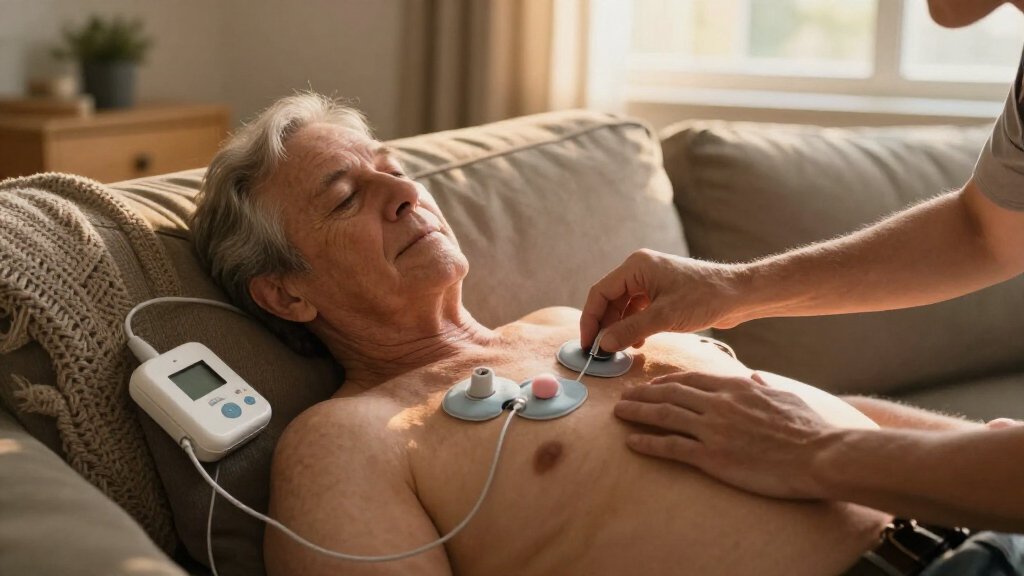
A separate presentation compared 10 people who received the subcutaneous implant in the first-in-human C-MIC III study with matched participants from C-MIC II. Researchers reported comparable changes in ejection fraction, six-minute walking distance and quality-of-life scores against matched controls. The subcutaneous procedure places the generator and lead under the skin and is performed in a catheterization lab under moderate sedation. The comparison was small and non-randomized, so it cannot establish that the newer approach works as well as surgery.
A Less Invasive Device Under Study
If larger trials confirm the reported effects, a subcutaneous delivery method could make C-MIC implantation less dependent on an operation to place the device on the heart’s outer surface. That may matter for people with heart failure with reduced ejection fraction, particularly those whose condition remains difficult to manage. The presentations do not show that the device reduces hospitalizations or extends survival, and they do not establish its place alongside existing care.
The debate at the meeting centered on how credible the reported size of the functional improvement is. Discussant John Teerlink described the magnitude as striking while saying he was skeptical of it. The contrast between promising measurements and substantial uncertainty is why the next study matters: a sham-controlled design can help distinguish a device effect from expectations, measurement differences and other sources of bias.
cardiac microcurrent therapy device
As an affiliate, we earn on qualifying purchases.
As an affiliate, we earn on qualifying purchases.
From Epicardial Implant to Skin
C-MIC was developed to apply small electrical currents with the aim of changing heart-muscle structure and function. The proposed mechanism is that microcurrents shift activated fibroblasts toward a less fibrogenic state, potentially reducing stiffness. This is a proposed explanation, not a mechanism proven by the reported clinical results.
In C-MIC II, 65 people with refractory, non-ischemic heart failure and reduced ejection fraction were randomized to surgical epicardial implantation or control. The trial reported improvements in ejection fraction, symptoms, functional capacity and quality of life at six months, while peak oxygen uptake in the original analysis only trended toward benefit. C-MIC III explored a subcutaneous version and included a different, very small group. Its earlier six-month results were reported as changes from baseline, not as evidence from a large controlled trial.
“I am highly skeptical of the magnitude of the benefit that you folks are showing, but I remain actually very enthusiastic about moving this forward.”
— John Teerlink, HFSA session discussant
subcutaneous implant for heart failure
As an affiliate, we earn on qualifying purchases.
As an affiliate, we earn on qualifying purchases.
Effect Size and Safety Questions
The available results cannot show whether C-MIC produces a reliable, clinically meaningful benefit. C-MIC II enrolled dozens rather than hundreds of participants and used an open-label design; the exercise-test reanalysis was post hoc and excluded two sites. C-MIC III’s first-in-human subcutaneous group had just 10 participants, and matched comparisons can leave differences between groups that affect results.
Safety and compatibility also need assessment. At the meeting, Teerlink asked how C-MIC might interact with existing devices and coronary stents, including defibrillators and cardiac resynchronization systems. The supplied report does not give a complete answer or detailed safety results. It also does not establish whether the reported changes will persist or translate into fewer heart-failure events.
heart failure microcurrent treatment
As an affiliate, we earn on qualifying purchases.
As an affiliate, we earn on qualifying purchases.
C-MIC IV to Test the Device
The next major planned study is C-MIC IV, described at the meeting as a sham-controlled crossover trial involving 60 people with ejection fractions of 20% to 40%. It is expected to include people with both ischemic and non-ischemic heart failure, broadening eligibility beyond the earlier studies. Simovic said participants will receive the subcutaneous device.
The trial’s results should help clarify whether the early measurements hold up under a more rigorous comparison and provide further information about use in a broader patient group. The source report does not specify a start date, completion date or detailed safety-monitoring plan. Until those data are available, C-MIC remains an investigational therapy rather than an established treatment.
As an affiliate, we earn on qualifying purchases.
Key Questions
What is cardiac microcurrent therapy?
C-MIC is an investigational implanted device intended to deliver small electrical currents to the heart. Researchers propose that it may affect heart-muscle structure, but the mechanism and clinical benefit have not been established.
Did the new analysis prove that C-MIC improves exercise capacity?
No. The post hoc analysis found statistically significant differences on some exercise-test measures, while the absolute peak oxygen uptake comparison did not reach conventional statistical significance. The small analysis requires confirmation in larger randomized research.
What is different about the subcutaneous implant?
Its generator and lead are placed under the skin rather than using the surgical epicardial approach studied in C-MIC II. Initial experience involved only 10 first-in-human participants, so the comparison is not conclusive.
What will C-MIC IV examine?
The planned 60-person sham-controlled crossover trial is expected to study people with ejection fractions of 20% to 40%, including those with ischemic and non-ischemic heart failure. The source report did not provide a timetable for the trial.
Source: rss
Cold & flu season Picks
humidifiers
As an affiliate, we earn on qualifying purchases.