TL;DR

Turn quiet afternoons into listening time
- Thousands of audiobooks, podcasts and originals
- Listen on your phone, tablet or Echo — also offline
- Cancel anytime
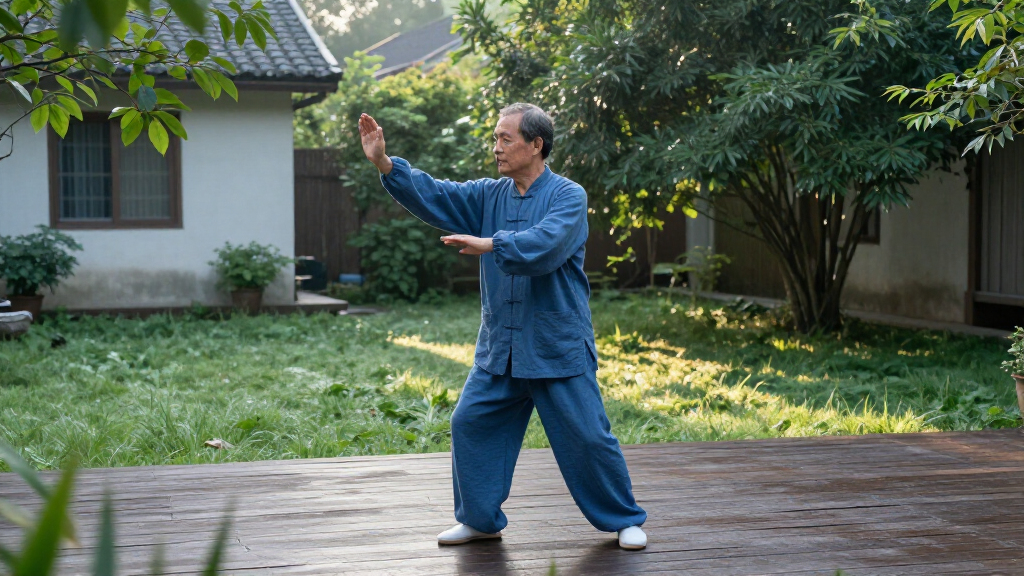
Tai Chi teacher Brian Thompson shared a four-part routine that Fit&Well describes as a five-minute way to begin the morning. The movements combine self-massage, slow arm motions, weight shifts and coordinated breathing; the source presents possible benefits for tension and focus, but provides no measurements or study results for this routine.
Tai Chi teacher Brian Thompson has shared a four-part morning routine that Fit&Well says takes about five minutes, offering readers a guided sequence of gentle movements and breathing. Thompson says the practice may help people feel less stiff and more focused, but the report does not provide evidence measuring those effects or show that they are guaranteed.
The sequence starts seated, either on a chair or at the edge of a bed. Practitioners massage the neck, arms, midsection and legs, then cup their hands and gently pat across the body. The report advises keeping an upright but relaxed posture and using a soft tapping motion rather than striking hard.
Next, practitioners stand with feet about shoulder-width apart for “lifting water,” raising relaxed arms to shoulder height while breathing in, then lowering them slowly while breathing out. Thompson’s instructions call for three to five repetitions, soft elbows and knees, and feet and knees aligned. The routine then moves into “silk reeling,” a slow sequence of waist turns, arm movements and shifts of bodyweight from one leg to the other; practitioners switch sides after first practicing one side slowly.
The final movement, “gather and release,” is also done three to five times. Practitioners raise their arms out to the sides and overhead with palms up, then turn the palms down and lower the hands to waist height. Across the standing movements, the instructions emphasize relaxed joints, smooth motion and breathing through the nose. Fit&Well presents the full set as a five-minute practice, though it does not specify how long to spend on each movement.
A Short Practice for Mornings
The routine offers a defined sequence for readers who want to try gentle movement soon after waking. Its instructions are specific enough to follow without equipment: the only suggested setup is a chair or the edge of a bed for the opening self-massage, followed by standing movements. The movements also give the practice a clear structure, progressing from body contact to coordinated arm and weight-shifting exercises.
Thompson connects morning practice with waking stiff joints, energy and focus. Those are his stated reasons for recommending it, rather than findings demonstrated in the report. The distinction matters because the article gives a practical routine but no clinical study, participant data or before-and-after measure of tension, concentration or wellbeing. Readers can understand what the sequence involves while treating its proposed benefits as attributed claims.
Thompson’s Tai Chi Guidance
Fit&Well describes Tai Chi as a mindful movement practice built around slow, intentional exercises and quotes Thompson, identified as a teacher and founder of bnew4life. He characterizes the practice as a way to address joint stiffness, muscle tightness and mental stress. The report does not give further detail about his training or the basis for these statements.
Thompson says Tai Chi can be practiced at any time of day, while suggesting that a morning session may help people start the day calmly. His routine combines several kinds of movement rather than a single repeated exercise: gentle self-massage, lifting and lowering the arms, a silk-reeling pattern with weight shifts, and raising and lowering the arms in a wave-like motion. The source describes nasal breathing as part of the instructions, including inhaling as the hands move inward and exhaling as they move outward during silk reeling.
““It works to gently release deep-seated joint stiffness, muscle tightness, and mental stress.””
— Brian Thompson, Tai Chi teacher
Evidence and Timing Details
The Fit&Well report does not identify research testing this particular four-part sequence, quantify changes in tension or focus, or say how many people have tried it. Its descriptions of benefits come from Thompson and should be read as his perspective. The report also does not set a precise duration for each movement, despite describing the full practice as five minutes.
It does not specify whether every reader can perform the standing movements comfortably, or provide modifications for people with mobility limitations. The instructions describe posture and movement, but do not discuss individual health conditions. Anyone with concerns about whether these exercises suit them can seek guidance from a qualified health professional.
How Readers Can Try It
Readers interested in the sequence can follow the four movements in the order provided: begin with seated self-massage and gentle patting, then move to lifting water, silk reeling and gather and release. Thompson’s instructions repeatedly call for a slow pace, relaxed joints and controlled breathing. The source offers no follow-up schedule or recommendation for how often to practice, so it does not establish a progression beyond describing this morning routine.
Further reporting or research would be needed to establish whether this specific practice changes stiffness, stress or concentration, and for whom. In the meantime, the published item is a set of instructor-attributed directions and proposed benefits, rather than a reported trial or a measured assessment of outcomes.
Key Questions
How long is the Tai Chi routine?
Fit&Well describes it as a five-minute practice. The report does not assign a specific duration to each of its four parts.
What are the four movements?
The routine consists of self-massage and Qigong body cupping, lifting water, silk reeling and gather and release. The first begins seated; the remaining movements are described standing.
Does the report prove the routine improves focus or releases tension?
No. Those benefits are described by Tai Chi teacher Brian Thompson. Fit&Well provides no measurements or study results for this particular routine.
What equipment is needed?
No equipment is listed. The opening movement uses a chair or the edge of a bed; the later movements are performed standing.
Source: rss
Fall Picks
fall essentials
As an affiliate, we earn on qualifying purchases.